What normal recovery can restore, when forensic examination may help, and what determines whether deleted messages still exist.
ORIGINAL PUBLICATION: 19 May 2019 REVISION COMPLETED: 18 September 2026 AEST
By Navid Sobbi, Founder and CEO, NSI Global
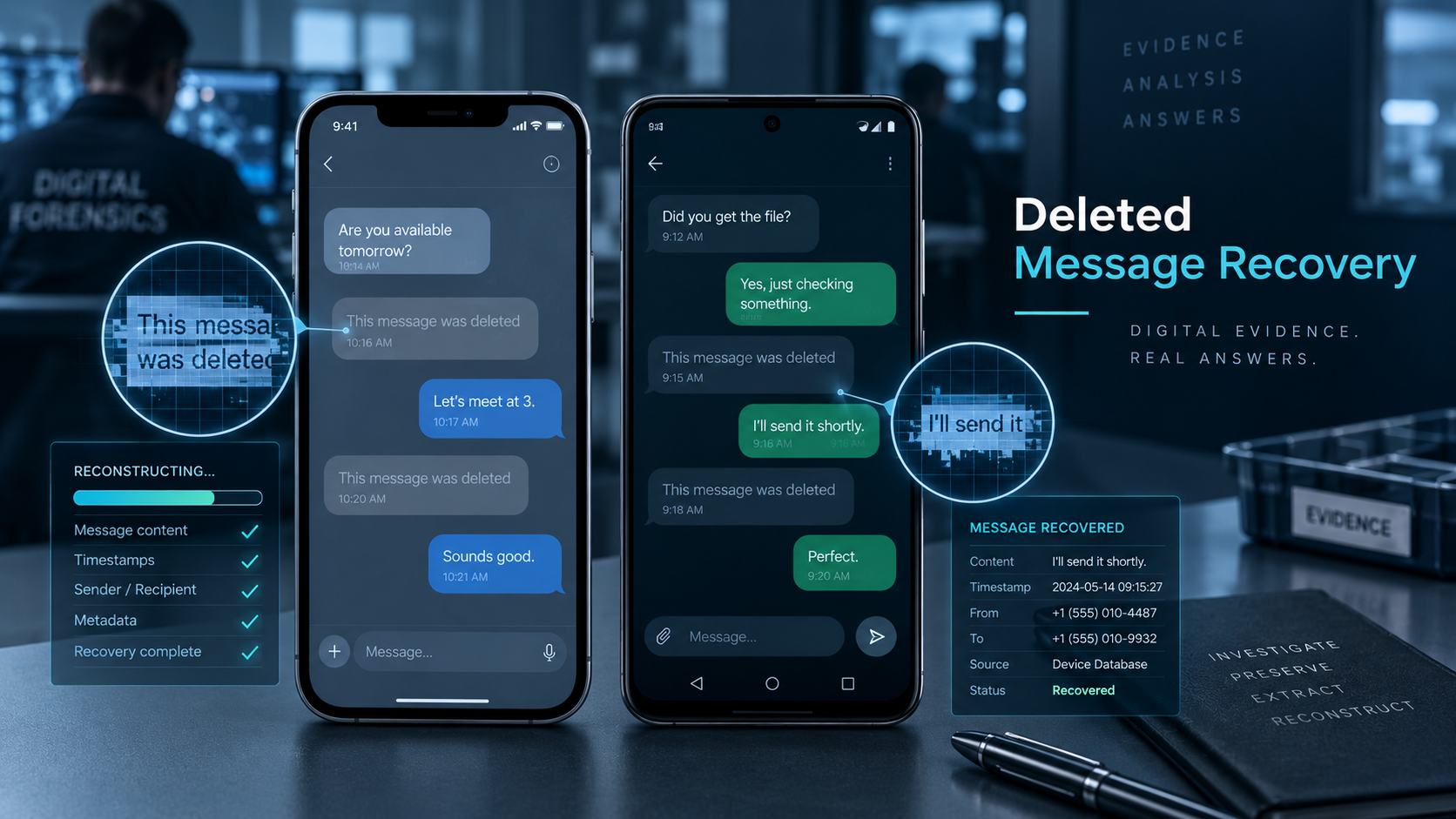
Deleted text messages can sometimes be recovered, but recovery is never guaranteed. The result depends on the phone, operating system, messaging application, how the message was deleted, whether backups or synchronised copies exist, encryption, how much the device has been used since deletion and the forensic acquisition methods available. In many cases the first place to look is not a forensic laboratory at all: current iPhones and Google Messages both provide built-in recovery windows for recently deleted conversations.
The important distinction is between normal restoration and forensic recovery. If the message is still in a Recently Deleted or Trash folder, restoration may take seconds. If it has been removed from those locations – or is required as evidence – the question becomes whether useful content, metadata or related artefacts still exist on the handset, in a backup, in a synchronised account, on another linked device, on removable media, or in another authorised data source.
Can Deleted Text Messages Be Recovered?
Sometimes. A message that looks deleted to the user may still exist in a built-in deleted-items area, a backup, a synchronised cloud service, another linked device, an application database, a database remnant, an attachment store, notification artefacts or another related source. In other cases the message content may have been securely removed, cryptographically rendered inaccessible, overwritten or purged by the application or operating system.
No legitimate forensic examiner should promise that every deleted message can be recovered. A defensible answer must be tied to the specific device, app, dates, deletion behaviour, backup configuration, security state and available acquisition methods.
First Check the Phone’s Built-In Recovery Features
Before treating an accidental deletion as a forensic problem, check whether the messaging platform itself still holds the conversation in a normal recovery area. This is especially relevant where the messages are personal and are not being preserved for litigation, an investigation or another evidentiary purpose.
iPhone: Recently Deleted
On current Apple devices, Messages includes a Recently Deleted area. Apple states that on iOS 16, iPadOS 16.1 or later, deleted messages and conversations can generally be restored if they were deleted within approximately 30 to 40 days. Once that normal recovery window has expired, recovery prospects depend on other sources and the forensic circumstances.
Google Messages: Trash
Google Messages now provides a Trash folder for deleted conversations. Google states that conversations can be restored from Trash within 30 days; once permanently deleted from Trash, that normal restore function no longer applies. Other Android messaging applications and manufacturer-specific apps can behave differently.
Important: If the phone or messages may be evidence, do not experiment with restores, resets, updates or third-party recovery apps before obtaining advice. The act of restoring or changing the device can alter data, timestamps, database state or the evidentiary record.
What Does “Deleted” Actually Mean on a Smartphone?
A message disappearing from the screen does not tell you where every related copy or artefact went. Modern messaging systems distribute information across the handset, databases, cloud services, backups, linked devices and application-specific storage. Recovery therefore begins by identifying the possible sources rather than assuming the message must be carved from raw phone memory.
| Potential Source | What May Exist | Key Limitation |
| Recently Deleted / Trash | A restorable conversation or message still retained by the platform. | Retention is time-limited and varies by platform or app. |
| On-Device Message Database | Current records, indexes, metadata or remnants associated with deleted conversations. | Modern databases, encryption and storage management may remove or obscure deleted content. |
| Cloud Synchronisation | Messages or related data synchronised through services such as iCloud or Google services. | Deletion can synchronise across devices; cloud behaviour differs from backup behaviour. |
| Device Backup | SMS, MMS, app data or message databases captured before deletion, depending on backup configuration. | A backup may pre-date or post-date deletion, and some synchronised data is excluded from normal backups. |
| Linked or Secondary Device | A Mac, iPad, tablet, desktop client or other paired device may contain related records. | The same deletion may have propagated to the linked device. |
| Application Artefacts | Attachments, thumbnails, notifications, logs, caches or database remnants that support context. | An artefact may show activity without reproducing the full message body. |
| SIM / UICC | In limited circumstances, message data or deleted records stored on the identity module. | Modern smartphones usually store most messaging data elsewhere; relevance is device- and carrier-dependent. |
Can Deleted Messages Be Recovered From an iPhone?
Yes, in some circumstances. The easiest case is a conversation still present in Recently Deleted. Beyond that, recovery depends on how Messages was configured, whether Messages in iCloud was enabled, whether relevant iCloud or computer backups exist, what other Apple devices were synchronised, and what the handset itself still contains.
Apple distinguishes between Messages in iCloud and ordinary iCloud Backup. When Messages in iCloud is enabled, messages are synchronised through iCloud and are not included in the device’s daily iCloud Backup. If Messages in iCloud is not enabled, SMS, MMS and iMessage content may be included in an iCloud Backup. This distinction matters when assessing whether an older copy could exist.
For forensic work, a specialist may need to examine the handset, available backups, synchronised sources and application artefacts together. A simple logical export may not expose the same material as a deeper acquisition, and the available method depends on the iPhone model, iOS version, security state and lawful access available.
Can Deleted Messages Be Recovered From Android?
Sometimes. Android is more variable because manufacturers, operating-system versions, messaging apps and backup configurations differ. Google Messages now provides a 30-day Trash window, but other messaging applications may use different retention models or no deleted-items folder at all.
Android backups can also contain SMS/MMS and other device data, depending on the device and backup configuration. A forensic examination may consider the handset, Google account data where lawfully accessible, application databases, attachments, notification artefacts, linked devices and any removable storage or UICC/SIM sources relevant to the matter.
The acquisition method matters. Current mobile-forensic guidance recognises that multiple tools and more than one acquisition method may be required because a logical extraction can omit deleted data that may be available through another technique or source.
SMS, iMessage, RCS and Encrypted Messaging Apps Are Not the Same
The phrase ‘text message’ now covers several technically different systems. Traditional SMS/MMS, Apple iMessage, RCS, WhatsApp, Signal, Telegram and other applications do not store, synchronise or delete data in the same way. That affects both normal restoration and forensic recovery.
| Message Type | Where Evidence May Exist | Recovery Considerations |
| SMS / MMS | Handset databases, backups, carrier-related records in limited contexts, UICC/SIM on some systems. | Carrier records may show metadata rather than message content; handset storage varies. |
| iMessage | iPhone/iPad/Mac databases, Messages in iCloud, backups when iCloud sync is not enabled. | Deletion may synchronise across Apple devices and cloud copies. |
| RCS / Google Messages | Google Messages database, Trash, Android backup and linked services. | Implementation and retention can vary by device and app version. |
| WhatsApp / Signal / Other Apps | Application databases, app backups, cloud or linked-device sources where the service permits them. | End-to-end encryption protects data in transit; forensic availability depends on endpoint and backup state. |
How Long After Deletion Can a Text Message Be Recovered?
There is no universal forensic recovery window. A message may remain recoverable for minutes, days, months, years, or not at all. The answer depends on where copies or artefacts exist and what happened after deletion.
Built-in restoration windows are easier to define: Apple currently allows recovery of eligible Messages content deleted within roughly 30 to 40 days, while Google Messages currently retains conversations in Trash for 30 days. Those product retention periods should not be confused with a forensic guarantee. After the normal window expires, another copy may still exist – or no recoverable content may remain.
What Determines Whether Recovery Is Possible?
| Factor | Why It Matters |
| Phone model and operating system | Storage, encryption, security state and acquisition options differ. |
| Messaging application | Each app has its own database, backup, sync and deletion behaviour. |
| Time since deletion | Longer periods can allow more database changes, retention expiry and storage reuse. |
| Continued device use | New messages, downloads, updates and ordinary app activity can alter relevant data. |
| Backups and synchronisation | An older copy may survive elsewhere, or deletion may have propagated to every synchronised device. |
| Factory reset or major update | Can substantially change what remains accessible and which artefacts survive. |
| Encryption and lock state | Modern mobile encryption can restrict which acquisition methods are possible. |
| Available forensic acquisition | Logical, file-system, backup, cloud and other acquisitions expose different classes of data. |
| Lawful access and scope | Investigators can only examine sources for which appropriate authority and instructions exist. |
Should You Turn the Phone Off?
Not automatically. Current mobile-forensic guidance treats device state as important evidence. If a device is already powered off, it should generally remain off until assessed. If a device is powered on – particularly if it is unlocked – powering it down can trigger stronger authentication or encryption states and may reduce data accessibility. A powered-on device is also dynamic and continues to change, so unnecessary handling should be minimised.
For an evidential phone, the safest public advice is therefore simple: stop unnecessary interaction and obtain specialist advice before changing its powered, locked, network or backup state.
Before Installing Message-Recovery Software
Do not assume that a failed consumer recovery attempt means the message is gone forever. Equally, do not assume that installing multiple recovery apps is harmless. Recovery or repair activity can create new files, modify databases, change metadata or alter the very evidence being assessed.
For a detailed explanation, read DIY Data Recovery Software: When It Can Destroy Evidence and What to Do Instead.
When Automated Recovery Does Not Tell the Whole Story
The original version of this article used a 10,000-piece jigsaw puzzle to explain why deleted data can be difficult to reconstruct. The analogy is still useful, but modern smartphone forensics requires more nuance. A forensic examiner may correlate message databases, database remnants, attachments, timestamps, notification artefacts, backups, linked-device records and other binary or application-level information to rebuild context.
The goal is not to claim that every fragment can be reassembled. Some deleted data is genuinely gone. The value of specialist analysis is in identifying what survives, validating its source, correlating it with other artefacts and stating clearly what the surviving evidence can and cannot establish.
Deleted Messages Needed for Court, Litigation or an Investigation
When deleted messages relate to fraud, employee misconduct, harassment, intellectual property theft, family-law proceedings, criminal matters, commercial disputes, insurance claims or regulatory investigations, the objective changes. It is no longer enough to display a recovered message on a screen.
A defensible forensic process should be able to explain the source of the data, the acquisition method, how the evidence was handled, what timestamps and metadata mean, whether the conversation is complete, what other artefacts support the interpretation, and what limitations remain. Screenshots can be useful leads, but they do not provide the same provenance or technical context as a properly acquired forensic record.
NSI Global conducts digital forensic work under evidence-aware procedures including chain-of-custody documentation, controlled acquisition, cryptographic hashing where applicable, analysis and expert reporting. Whether particular material is admissible or the weight it receives is ultimately a legal question for the relevant proceeding, not something a recovery tool can guarantee.
NSI Global’s Nine-Stage DFIR-EDM Methodology
Where deleted communications are potentially evidential, NSI Global applies its structured Digital Forensic Incident Response and Electronic Discovery Model (DFIR-EDM). The nine stages provide a documented pathway from lawful instruction through reporting.
| Stage | Purpose |
| 1. Legal Notices | Confirm authority, scope, preservation obligations and instructions. |
| 2. Chain of Custody | Document possession, transfers and evidence identifiers. |
| 3. Preservation | Protect relevant devices, accounts and data from avoidable alteration or loss. |
| 4. Collection | Acquire relevant data using methods appropriate to the device and matter. |
| 5. Processing | Prepare acquired data for parsing, indexing, recovery and examination. |
| 6. Analysis | Examine messages, databases, metadata, timelines and related artefacts. |
| 7. Review | Validate relevance, interpretation, limitations and legal-review requirements. |
| 8. Production | Prepare authorised evidence or datasets for the required stakeholders. |
| 9. Reporting | Document methods, findings, limitations and conclusions for scrutiny. |
How NSI Global Approaches Deleted Message Recovery
NSI Global’s Digital Forensic Unit assesses the whole evidence environment rather than relying on a single recovery utility. Depending on the matter, that may involve examination of the handset, local and cloud backups, synchronised devices, social-media or messaging accounts, application databases, UICC/SIM data, attachments and related artefacts where lawful authority exists.
Professional mobile forensics may require more than one validated tool or acquisition method. Current forensic guidance recognises that a logical extraction can miss deleted data that may be available through another acquisition or source. NSI Global’s role is to select a proportionate method, preserve the evidentiary record, analyse what is actually available and report the result without overstating certainty.
For matters intended for legal, corporate, regulatory, insurance or investigative use, findings can be documented with chain of custody, technical methodology and expert reporting. Where appropriate, NSI Global’s court-experienced forensic specialists can support affidavits and expert evidence.
Related NSI Global resources: Digital Forensic Data Recovery | Digital Forensics | Social Media and Cloud Forensics | Digital Forensic Incident Response
Frequently Asked Questions
Can Permanently Deleted Text Messages Be Recovered?
Sometimes, but not always. ‘Permanently deleted’ usually means the normal app restore function no longer applies. A forensic examination may still identify copies or artefacts in backups, synchronised sources, databases, linked devices or other authorised locations. If the relevant content has been overwritten, cryptographically destroyed or purged with no surviving copy, it cannot be recreated from nothing.
Can Deleted iMessages Be Recovered?
Eligible iMessages may be restored from Apple’s Recently Deleted feature within the normal retention window. Outside that window, recovery depends on Messages in iCloud, backups, linked Apple devices, handset artefacts and the available forensic acquisition methods.
Can Deleted SMS Messages Be Recovered From Android?
Sometimes. Google Messages currently provides a 30-day Trash window. Outside normal restore functions, recovery depends on the Android device, app, backup configuration, database state, encryption and forensic access available.
How Far Back Can Deleted Text Messages Be Recovered?
There is no universal forensic time limit. Built-in restoration periods are defined by the app, but forensic availability depends on surviving copies and artefacts. A message from years ago may survive in a backup while a recently deleted message may already be unrecoverable.
Can Deleted Messages Be Recovered Without a Backup?
Potentially. A backup is only one possible source. Relevant content or metadata may still exist on the device, in a deleted-items folder, on a synchronised device, in cloud data, in an application database or in other related artefacts.
Can Messages Be Recovered After a Factory Reset?
A modern factory reset can severely reduce handset recovery prospects, particularly on encrypted devices. However, backups, synchronised cloud services, linked devices or other authorised data sources may still contain relevant information.
Can Deleted WhatsApp, Signal or Other App Messages Be Recovered?
Possibly, but each application behaves differently. Recovery depends on the endpoint database, backup model, linked devices, cloud configuration, encryption, deletion behaviour and what data remains available. End-to-end encryption does not by itself mean no forensic artefacts exist on an authorised endpoint.
Can Recovered Messages Be Used in Court?
Potentially. The legal admissibility and weight of digital evidence depend on the proceeding and the way the evidence was obtained, authenticated and presented. Forensic acquisition, chain of custody, hashing where applicable and clear expert reporting can strengthen the ability to demonstrate provenance and integrity.
Should I Turn My Phone Off If I Need Deleted Messages Recovered?
Do not automatically change an evidential phone’s state. If it is already off, leave it off. If it is powered on or unlocked, powering down can engage stronger security states and reduce data accessibility. Stop unnecessary interaction and seek forensic advice before changing the device state.
What to Do Now If the Messages Matter
If the messages are still within the phone’s normal Recently Deleted or Trash window and they are purely personal, use the platform’s built-in recovery function. If the messages may be evidence, are no longer available through normal recovery, or relate to a legal, corporate, regulatory, insurance or investigative matter, stop unnecessary interaction with the phone and preserve the device, accounts and related sources before experimenting with recovery tools.
Contact NSI Global from a separate trusted device or environment so the preservation and acquisition strategy can be considered before further evidence is altered.
Sources and Further Reading
- Apple Support – Recover deleted text messages on your iPhone or iPad
- Apple Support – What does iCloud back up?
- Apple Support – Missing information after restoring an iPhone or iPad with iCloud Backup
- Google Messages Help – Manage Trash folder in Google Messages
- Android Help – Back up your phone
- SWGDE – Best Practices for Mobile Device Evidence Collection, Preservation, Handling and Acquisition
- SWGDE – Core Competencies for Mobile Device Forensics
- NSI Global – Digital Forensics
- NSI Global – Social Media and Cloud Forensics