
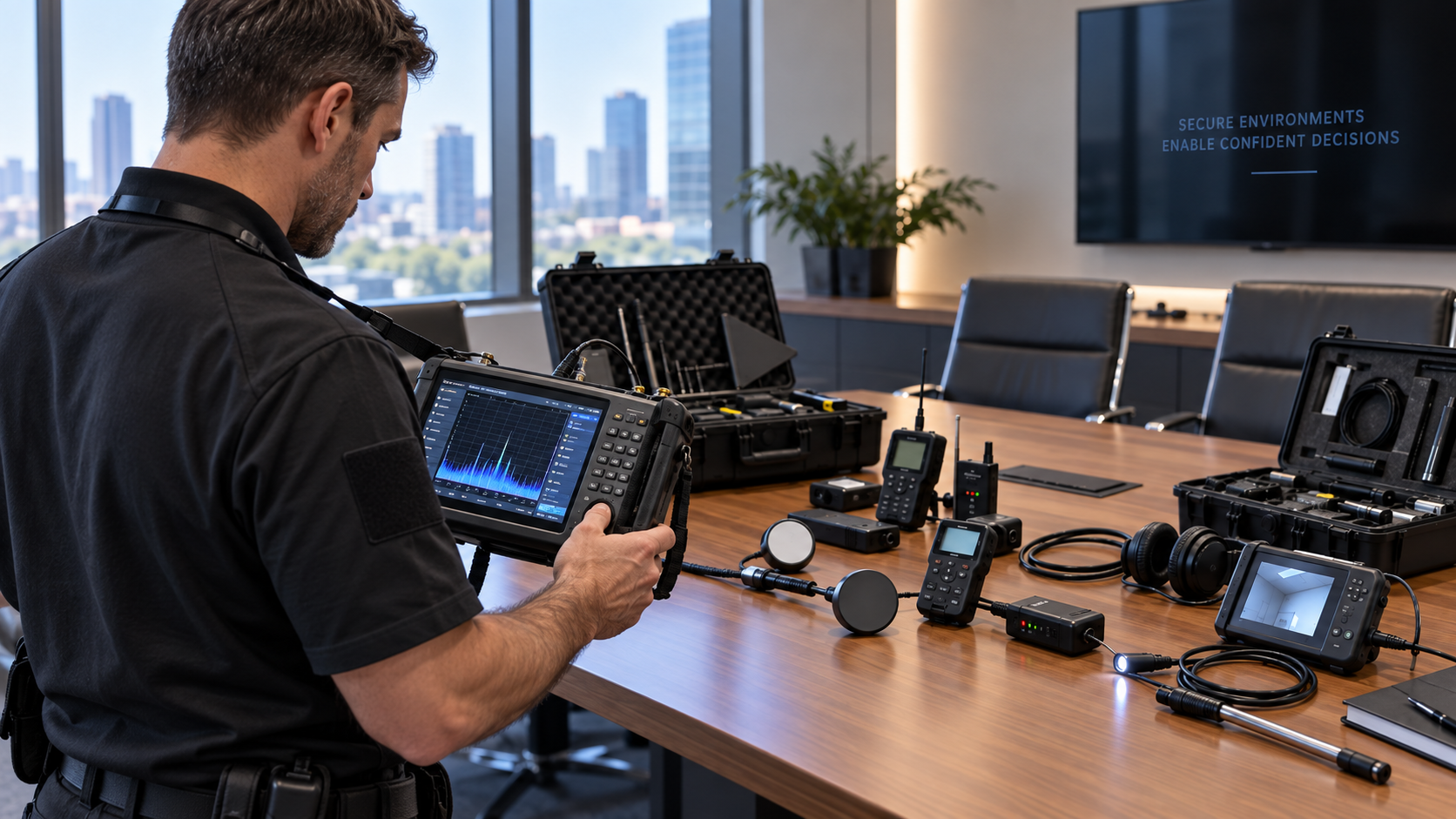
Why RF scanning alone is not enough to detect modern listening devices, hidden cameras, trackers and non-transmitting surveillance technology.
By Navid Sobbi, Founder and CEO, NSI Global
ORIGINAL PUBLICATION: 14 February 2020 REVISION COMPLETED: 21 September 2026 AEST
A professional bug sweep is not a single scan for radio signals. Modern eavesdropping technology can transmit continuously, communicate only at selected times, use cellular or Wi-Fi networks, record locally without transmitting, remain dormant until triggered, hide inside legitimate electronics or collect information through an optical pathway from outside the room. Detecting those threats requires a properly scoped Technical Surveillance Counter Measures (TSCM) investigation that combines complementary methods.
That distinction is important because an RF detector can answer only a narrow question: whether radio-frequency energy is present within the instrument’s capabilities and the conditions of the inspection. It cannot, by itself, establish that every suspicious device has been located or that an environment is permanently free from surveillance.
A responsible TSCM conclusion is therefore bounded by the locations examined, access provided, threat model, equipment and methods used, environmental conditions and the time of inspection. The objective is to identify and assess surveillance indicators, locate devices or vulnerabilities where possible, preserve evidence appropriately and reduce residual risk – not to sell an impossible universal ‘all clear’.
What Is a Professional TSCM Bug Sweep?
Technical Surveillance Counter Measures is the specialist discipline used to detect, identify and mitigate covert technical surveillance threats. United States government definitions describe TSCM as techniques and measures used to detect and nullify technologies intended to obtain unauthorised access to sensitive information. NSI Global’s current TSCM service similarly describes the work as a systematic inspection of physical, electronic and communications environments for hidden microphones, cameras, trackers, burst transmitters and interception equipment.
Related NSI capability: Technical Surveillance Counter Measures (TSCM)
The word ‘sweep’ can be misleading if it suggests one instrument or one pass through a room. A properly scoped survey may involve visual and physical examination, radio-frequency and spectrum analysis, electronic inspection, telecommunications and network assessment, inspection of cabling and power infrastructure, thermal or optical methods, nonlinear-junction detection and targeted examination of vehicles or devices where the threat hypothesis requires it.
Why No Single Bug Detector Can Find Every Surveillance Device
Surveillance devices do not all behave in the same way. A continuously transmitting microphone creates a very different detection problem from a camera recording to local storage, a tracker reporting only periodically, an electronic device concealed inside legitimate equipment or an external laser-microphone system directed at a window.
This is why a useful TSCM investigation begins with the threat question rather than the instrument. What information may be exposed? Where is it discussed or stored? Who could gain access? Which communications pathways exist? Are there indicators suggesting a planted device, vehicle tracking, account compromise, insider activity or an external line-of-sight threat? The answers determine which methods deserve priority.
| Threat Type | Typical Behaviour | Why RF Alone May Fail | TSCM Considerations |
| Active RF transmitter | Transmits audio, video or data by radio. | RF analysis may detect activity, but attribution and intermittent operation still matter. | Spectrum analysis, signal identification, direction finding and physical confirmation. |
| Cellular-connected device | Uses mobile-network connectivity rather than local Wi-Fi. | Traffic may resemble legitimate cellular activity and the device may transmit selectively. | Cellular-threat assessment, signal analysis, physical inspection and contextual attribution. |
| Wi-Fi / Bluetooth device | Uses common local wireless protocols. | Legitimate corporate and personal devices create dense RF environments. | Network inventory, RF attribution, physical inspection and comparison with authorised equipment. |
| Passive recorder | Stores audio or video locally for later retrieval. | May emit no useful RF signal while recording. | Physical inspection, electronic examination, thermal assessment and nonlinear-junction detection where appropriate. |
| Hidden camera | May be wired, wireless or record locally. | Some cameras do not transmit during the inspection. | Optical/physical inspection, electronics detection, thermal methods and RF/network analysis where relevant. |
| Concealed electronics | Hidden inside chargers, power supplies, furniture or legitimate equipment. | The host device may mask the purpose and emissions of the concealed electronics. | Baseline comparison, physical inspection, nonlinear-junction/electronic detection and targeted dismantling where authorised. |
| Vehicle / location tracker | May use cellular, Bluetooth/location networks, local logging or other reporting methods. | Not every tracker continuously transmits or uses the same communications method. | Vehicle inspection, RF/cellular assessment, physical search and location-alert context. |
| Optical / laser eavesdropping | Collects vibration or optical information from outside the protected room. | It may involve no planted RF transmitter inside the room. | Line-of-sight assessment, glazing/optical vulnerability review and appropriate countermeasures. |
| Compromised phone or computer | Uses software, account access or endpoint compromise. | The surveillance pathway may exist entirely within an authorised device. | Digital forensics, account review and COMSEC assessment rather than room RF testing alone. |
1. RF and Spectrum Analysis: Detecting Active Transmitters
Radio-frequency analysis remains an important part of TSCM because many covert devices communicate wirelessly. A professional inspection can examine the electromagnetic environment, identify unexplained emissions, compare signals with legitimate infrastructure and investigate whether suspicious activity is associated with a physical location or device.
The difficulty is attribution. Modern offices already contain Wi-Fi access points, Bluetooth peripherals, mobile phones, wireless presentation systems, IoT devices, building-management systems and other emitters. Detecting energy is not the same thing as proving that the signal is malicious. Equally, the absence of a suspicious transmission during a limited observation period does not prove that no device is present.
Burst transmitters, remotely activated devices and scheduled communications illustrate the problem: a device can remain quiet during part of the inspection and communicate later. That is why RF work must be interpreted alongside other evidence rather than treated as a complete sweep by itself.
2. Cellular-Connected Listening and Surveillance Devices
The older term ‘GSM bug’ is still widely used, but it no longer describes the full cellular threat. Contemporary covert devices can use modern mobile-network connectivity and may communicate independently of the target organisation’s Wi-Fi environment. Depending on design and configuration, they may transmit audio, video, location or status information over a cellular service.
A cellular-connected device may be difficult to distinguish from legitimate mobile activity without context. A professional investigation therefore considers the cellular environment together with physical access, expected equipment, unexplained electronics and other indicators. The objective is not merely to observe cellular traffic; it is to determine whether a suspicious device or pathway can be attributed to the environment under examination.
3. Wi-Fi, Bluetooth and Network-Connected Devices
Covert surveillance can also use ordinary networking technologies. This creates a different problem from detecting a dedicated analogue transmitter because the communications method itself may be entirely legitimate. A hidden camera connected to Wi-Fi, for example, may coexist with dozens or hundreds of authorised devices.
A TSCM investigation can therefore require comparison between RF observations, network inventories and the physical environment. Unknown devices, unexpected access points, unexplained wireless activity or equipment that does not match the authorised baseline may justify further investigation. Network data alone should not be used to label an innocent device as surveillance technology.
4. Passive Recorders and Devices That Do Not Transmit
One of the most important limitations of a basic RF sweep is that a covert device does not have to transmit at all. Audio recorders, cameras and modified electronics can store information locally for later retrieval. Other devices may transmit only when triggered or at scheduled intervals.
When a device is not transmitting, detection may depend on physical inspection and methods that identify the electronics themselves rather than their radio emissions. This can include examining fixtures, furniture, power supplies, cabling and legitimate electronics for anomalies, using thermal information where it is meaningful, and applying electronic detection methods such as nonlinear-junction detection where appropriate.
Published research on harmonic radar – a technology related to nonlinear-junction detection – demonstrates that electronic components can produce nonlinear responses that help reveal the presence of concealed electronics. That does not mean every electronic anomaly is a surveillance device; legitimate semiconductor junctions can also produce responses, so findings still require interpretation and physical confirmation.
5. Nonlinear-Junction Detection and Concealed Electronics
A nonlinear junction detector (NLJD) is designed to help identify semiconductor junctions that may be present in concealed electronics. It can be useful when the suspected device is not transmitting, is powered down, or is hidden inside a location where a simple RF scan would reveal nothing.
An NLJD is not a magic ‘bug finder’. Modern premises contain vast numbers of legitimate electronic components, and some non-electronic junctions can also create confusing responses. Skilled use depends on understanding the environment, comparing expected and unexpected findings, inspecting the suspected location and correlating the result with other TSCM methods.
6. Thermal and Physical Inspection
Physical examination remains fundamental because surveillance devices must exist somewhere in the environment unless the collection pathway is entirely external or software-based. A professional inspection looks for signs that do not fit the expected baseline: altered fixtures, unexplained wiring, modified power supplies, unfamiliar adapters, displaced fasteners, unusual apertures, devices that should not be present or electronics that have been added to legitimate equipment.
Thermal imaging can sometimes help identify powered electronics or abnormal heat patterns, but heat is not proof of surveillance. Many legitimate devices generate heat and some covert devices may generate little useful thermal contrast. Thermal information is therefore an investigative indicator, not a standalone conclusion.
Related NSI case study: Many Bugs Go Undetected by Standard Bug Sweeps
The practical lesson is that a transmitter-only approach can miss a threat that becomes apparent only when multiple observations are combined.
7. Hidden Cameras Require More Than a Radio Scan
Hidden cameras can be wired, wireless, network-connected or self-contained. Some stream continuously; others record to local storage; some activate only when movement occurs. A camera concealed within an ordinary object may therefore present little or no useful RF signature during an inspection.
Detection can involve physical and optical inspection, analysis of suspicious electronics, network and RF assessment where the camera communicates wirelessly, thermal information where appropriate and targeted examination of areas with a plausible view of sensitive activity. The purpose is to identify the device and understand how it collects or transmits information, not merely to trigger a generic detector.
8. Vehicle and GPS Tracker Detection
Vehicle tracking is not limited to one technology. A device may determine position using satellite navigation while communicating through cellular networks; another may use a Bluetooth or location-network ecosystem; another may log information locally; and hardwired devices may draw power from the vehicle.
For that reason, there is no universal battery-life assumption and no single signal that proves a tracker is present. A properly scoped vehicle TSCM inspection can combine physical examination of the vehicle, assessment of suspicious electronics, RF and cellular observations, consideration of location-network alerts and examination of installation points consistent with the threat model.
If a suspicious tracker is found in a legal, employment, domestic-violence or criminal matter, immediate removal may not always be the best evidentiary step. Personal safety takes priority, but where circumstances permit, the device and surrounding evidence should be documented and handled in a way that preserves its potential investigative value.
9. Laser Microphones and Other Optical Eavesdropping Threats
Not every eavesdropping pathway requires a device to be planted inside the protected space. Optical systems such as laser microphones can attempt to recover speech-related vibration from windows or other surfaces from an external line of sight. An RF sweep of the boardroom may therefore find nothing because the collection equipment is outside the room and the relevant pathway is optical rather than a conventional internal transmitter.
Related NSI case study: TSCM Case Study: Laser Microphone Risk in a High-Rise Boardroom
A complete assessment of an exposed executive area may therefore need to consider external vantage points, glazing, room layout and the sensitivity of discussions in addition to electronic emissions inside the room.
10. When the ‘Bug’ Is Actually a Phone, Computer or Account
A suspected eavesdropping incident can originate from an authorised device rather than a planted bug. Spyware on a mobile phone, compromised cloud credentials, an unauthorised linked device, remote-access software or account takeover can expose conversations and information while leaving the room technically clean.
This is where TSCM and digital forensics need to work together. If the indicators point toward endpoint or account compromise, repeatedly scanning the room for RF emissions will not answer the underlying question. The correct next step may be forensic preservation and examination of the relevant phone, computer, account or communications environment.
Related NSI capability: Forensic Spyware and Malware Detection
Why Consumer RF Bug Detectors Have Limits
Consumer RF detectors can sometimes alert a user that radio-frequency energy is nearby. That can be useful in a narrow sense, but it is not equivalent to a professional TSCM survey. A simple detector may react to legitimate Wi-Fi, Bluetooth, mobile phones, routers, smart devices and other normal electronics, creating false alarms without identifying what the signal actually represents.
More importantly, a consumer RF detector cannot reliably address surveillance technology that is not transmitting at the time of the search, devices that store information locally, optical eavesdropping, concealed electronics that require physical examination, or spyware operating inside an authorised phone or computer.
The correct conclusion is not that every consumer detector is worthless. It is that a detector is only one instrument answering one type of question. Confidence comes from the scope, methodology and interpretation of the overall investigation.
What Does a Negative TSCM Result Actually Mean?
A negative result should never be presented as proof that a location can never be monitored. It means that the examination did not identify reportable evidence of the defined surveillance threats within the locations, time period, access conditions and methods used.
That distinction matters because surveillance risk changes. A device can be introduced after the sweep. A dormant device can activate later. A previously inaccessible location may remain unexamined. New staff, contractors, renovations, sensitive transactions, litigation, executive travel or suspicious incidents can change the threat profile.
For higher-risk organisations, TSCM is therefore more effective when treated as part of a security program with risk-based scheduling and event-triggered inspections rather than as a one-off certificate that a room is ‘clean forever’.
What Happens if a Suspicious Device Is Found?
The response depends on the circumstances. In a corporate, legal or investigative matter, the device may itself become evidence. Photographing its position, documenting connections, preserving surrounding materials, controlling access and determining who should handle or examine it can be more important than immediately disabling it.
Where there is an immediate personal-safety risk, safety takes priority over perfect evidence preservation. Where litigation, employment action, criminal investigation or regulatory reporting may follow, legal counsel, law enforcement or another authorised stakeholder may need to be involved before the device is moved or altered.
The Legal Position: Surveillance Devices Are Not Universally ‘Illegal’
The original version of this article stated that all such devices were illegal under surveillance-device legislation. That is too broad. In New South Wales, the Surveillance Devices Act 2007 regulates listening, optical, tracking and data-surveillance devices, but the prohibitions and exceptions differ according to the device type and circumstances.
For example, the NSW Surveillance Devices Commissioner explains that listening-device prohibitions operate differently from optical-surveillance restrictions, and that the Act contains specific exceptions including authorised law-enforcement use. Whether a particular installation or use is lawful can depend on consent, location, purpose, jurisdiction and other facts.
Where surveillance evidence may affect litigation, employment, family-law, criminal or regulatory proceedings, obtain legal advice rather than assuming that possession of a device alone determines legality.
How NSI Global Approaches Professional TSCM
NSI Global’s current TSCM service describes a systematic visual, electronic and physical examination designed to detect covert surveillance and identify technical-security weaknesses. Depending on the threat and agreed scope, an engagement may assess offices, boardrooms, executive areas, corporate residences, vehicles, telecommunications pathways and other locations associated with sensitive information.
NSI Global also publicly states that its TSCM Unit uses specialist ITAR export-controlled detection equipment and conducts corporate and government TSCM across Australia and internationally. Equipment capability matters, but the quality of an investigation also depends on threat assessment, practitioner experience, access, method selection, interpretation and reporting.
For residential domestic-violence, family-law, child-safety and related sensitive matters, NSI Global’s current service policy requires an appropriate case-managed or authorised pathway, such as instruction or referral through a law firm, law-enforcement agency, government department, recognised support organisation, authorised investigator or case officer.
Learn more: NSI Global Bug Sweeping Services
Frequently Asked Questions
Can a Bug Sweep Detect a Device That Is Switched Off?
Sometimes a powered-down or non-transmitting electronic device may still be identified through physical inspection, nonlinear-junction detection or other electronic examination, but no single method guarantees detection in every environment. Concealment, access and the device’s construction still matter.
Can a Listening Device Record Without Transmitting?
Yes. A device can store audio or video locally for later retrieval. This is one reason an RF-only scan cannot provide complete assurance.
Can Hidden Cameras Be Detected Without an RF Signal?
Potentially. Depending on the camera and environment, detection may involve visual and physical inspection, optical examination, nonlinear-junction/electronic methods, thermal information or examination of network and power infrastructure.
Can a Bug Detector Find Every Surveillance Device?
No. A bug detector is an instrument, not a complete methodology. It may identify certain RF activity but cannot by itself rule out non-transmitting recorders, dormant devices, concealed electronics, optical surveillance or compromised authorised devices.
Can TSCM Detect GPS or Vehicle Trackers?
A properly scoped vehicle inspection can examine for tracking devices using a combination of physical, electronic, RF/cellular and contextual methods. The appropriate approach depends on the type of tracker and how it determines, stores or communicates location.
Can a Laser Microphone Be Found by an RF Sweep?
Not necessarily. A laser microphone is fundamentally an optical eavesdropping threat. The relevant collection equipment may remain outside the room, so line-of-sight and glazing vulnerability must be assessed rather than relying only on RF emissions inside the protected space.
What Is an NLJD?
A nonlinear junction detector is an instrument used to identify nonlinear electronic junctions associated with semiconductor components. It can assist in locating concealed electronics even when they are not transmitting, but responses require interpretation because legitimate electronics and other junctions can also produce signals.
What Should I Do if I Find a Suspicious Device?
Avoid unnecessary handling if the device may be evidence. Where safe, document its location and obtain appropriate technical, legal or law-enforcement advice before disconnecting, dismantling or disposing of it. Personal safety should take priority where an immediate risk exists.
How Often Should a TSCM Sweep Be Conducted?
There is no universal interval. Frequency should be risk-based and may increase around sensitive transactions, litigation, executive changes, renovations, suspicious incidents, high-level meetings, foreign travel or other events that materially change the threat environment.
Sources and Further Reading
- NSI Global – Technical Surveillance Counter Measures (TSCM) – Current NSI Global description of systematic TSCM, covert-device classes and reporting.
- NSI Global – Bug Sweeping Services – Current corporate, vehicle and case-managed residential TSCM scope and service policy.
- NSI Global – Many Bugs Go Undetected by Standard Bug Sweeps – Related NSI case study on the limitations of narrowly scoped or transmitter-only bug sweeps.
- NSI Global – TSCM Case Study: Laser Microphone Risk in a High-Rise Boardroom – Related NSI analysis of an optical/line-of-sight surveillance pathway.
- U.S. Code of Federal Regulations – Technical Surveillance Countermeasures definition – Government definition of TSCM as techniques and measures to detect and nullify technical surveillance technologies.
- U.S. Department of State – Technical Surveillance Countermeasures Branch – Describes the Department’s TSCM inspection and technical-security functions.
- Perez et al. – Detecting the Presence of Electronic Devices in Smart Homes Using Harmonic Radar Technology – Open-access research on harmonic radar / nonlinear-junction approaches for detecting concealed electronic devices.
- NSW Department of Communities and Justice – Scheme of the Surveillance Devices Act 2007 – Official summary of NSW prohibitions and exceptions for listening, optical, tracking and data-surveillance devices.