Corporate espionage rarely follows a single surveillance pathway. This guide explains how organisations can scope a professional TSCM bug sweep around the information at risk, credible threat actors, relevant locations, technical collection methods and the limitations of a negative result.
By Navid Sobbi, Founder and CEO, NSI Global
ORIGINALLY PUBLISHED: 26 June 2023 SUBSTANTIALLY REVISED: 9 October 2026.
Technical Surveillance Counter Measures—or TSCM—is the disciplined process of finding, assessing and reducing technical surveillance risks in places where sensitive information is discussed, displayed, stored or transmitted. It is often called a bug sweep, but a professional TSCM survey is broader than searching for a radio signal.
A technical surveillance countermeasures survey can provide valuable assurance about a defined environment at a defined time. It cannot protect a business from every surveillance pathway merely because one meeting room was swept or no covert device was found.
The usefulness of a TSCM engagement depends on its scope: the information being protected, the people and threat actors involved, the locations and systems through which it could be captured, the inspection methods selected and the period during which observation occurs.
For boards, legal teams and security leaders, the central question is therefore not simply, “When was our last bug sweep?” It is:
Did the commissioned survey cover the credible ways our sensitive information could be obtained?
This article explains how organisations can develop a proportionate TSCM scope, understand the limits of a negative result and decide when a one-off survey should be supported by live monitoring, repeat inspections or wider counterintelligence controls.
Begin With the Information That Requires Protection
A defensible scope starts with the asset, discussion or decision at risk—not with a predetermined list of rooms or instruments.
The organisation should identify what an adversary could exploit, such as:
- Merger, acquisition or divestment plans;
- Tender pricing and negotiation strategy;
- Legal advice, litigation positions or regulatory responses;
- Intellectual property, research and product-development information;
- Board deliberations and executive succession plans;
- Government, defence or critical-infrastructure information;
- Customer, employee or transaction data;
- Crisis-management decisions; and
- Commercially sensitive conversations with investors, lenders or partners.
This asset-led approach determines where meaningful discussions occur, who participates, which devices and communication systems are used and how long the heightened exposure is likely to continue.
A boardroom may be an obvious location, but it may not be the most important one. Executives may discuss the same matter in private offices, vehicles, residences, hotel rooms, temporary project sites, airport lounges or through conferencing equipment and connected devices. A narrow room list can therefore create an appearance of assurance without covering the real information path.
Define the Threat Before Selecting the Methods
Different actors have different access, resources, incentives and opportunities. A generic concern about “corporate espionage” is not yet a useful examination brief.
The threat assessment should consider whether the credible actor is:
- An employee or contractor with legitimate physical access;
- A commercial competitor or party to a transaction;
- A former employee retaining knowledge, keys, credentials or relationships;
- An organised criminal group seeking financial or confidential information;
- An activist or issue-motivated actor;
- A private party involved in litigation or a commercial dispute; or
- A foreign state or state-linked organisation interested in technology, policy or strategic decisions.
An insider may be able to introduce a recording device, abuse meeting technology or collect information directly. A remote actor may focus on conferencing platforms, wireless access or compromised accounts. A sophisticated external actor may exploit optical, acoustic, cellular or supply-chain channels that a basic RF check does not address.
The purpose of threat modelling is not to assume the most dramatic explanation. It is to connect plausible access and intent to the methods needed to test the exposure.
Scope Every Environment Through Which Information Travels
An effective survey boundary should be recorded explicitly. Depending on the risk profile, relevant environments may include:
| Scope domain | Examples to consider | Risk if omitted |
| Primary rooms | Boardrooms, executive offices, legal rooms, data rooms and negotiation spaces | The core discussion environment remains unexamined or only partly examined. |
| Adjacent and service areas | Ceiling voids, risers, cupboards, plant areas, shared walls, corridors and accessible adjoining rooms | A device or collection point may operate from outside the nominal room boundary. |
| Meeting technology | Displays, conferencing units, telephones, chargers, adaptors and room-control systems | Legitimate equipment can conceal modifications, configuration risk or unauthorised access. |
| Wireless environment | Relevant RF bands, Wi-Fi, Bluetooth, cellular and other authorised or unknown emitters | Transmitting activity may be missed or misclassified without suitable observation and analysis. |
| Executive mobility | Vehicles, residences, temporary venues and travel accommodation | Sensitive conversations may move outside corporate premises. |
| Information systems | Network, endpoint, identity or communications artefacts where separately authorised | A cyber or account-based surveillance channel may be mistaken for a physical bug. |
| External observation | Windows, sight lines, acoustic leakage and accessible perimeter positions | Information may be collected without placing equipment inside the room. |
Not every engagement needs every domain. The scope should be broad enough to address the credible threat while remaining lawful, proportionate and operationally manageable.
Restrictions must also be documented. If access to a ceiling void, leased telecommunications cabinet, executive device, third-party venue or adjoining tenancy is unavailable, the report should identify the resulting limitation rather than silently implying that the area was cleared.
RF Scanning Is One Method, Not the Entire Survey
The term “bug sweep” is often used as though the exercise consists of walking through a room with a handheld detector. That is not an adequate description of a professional, risk-based TSCM survey.
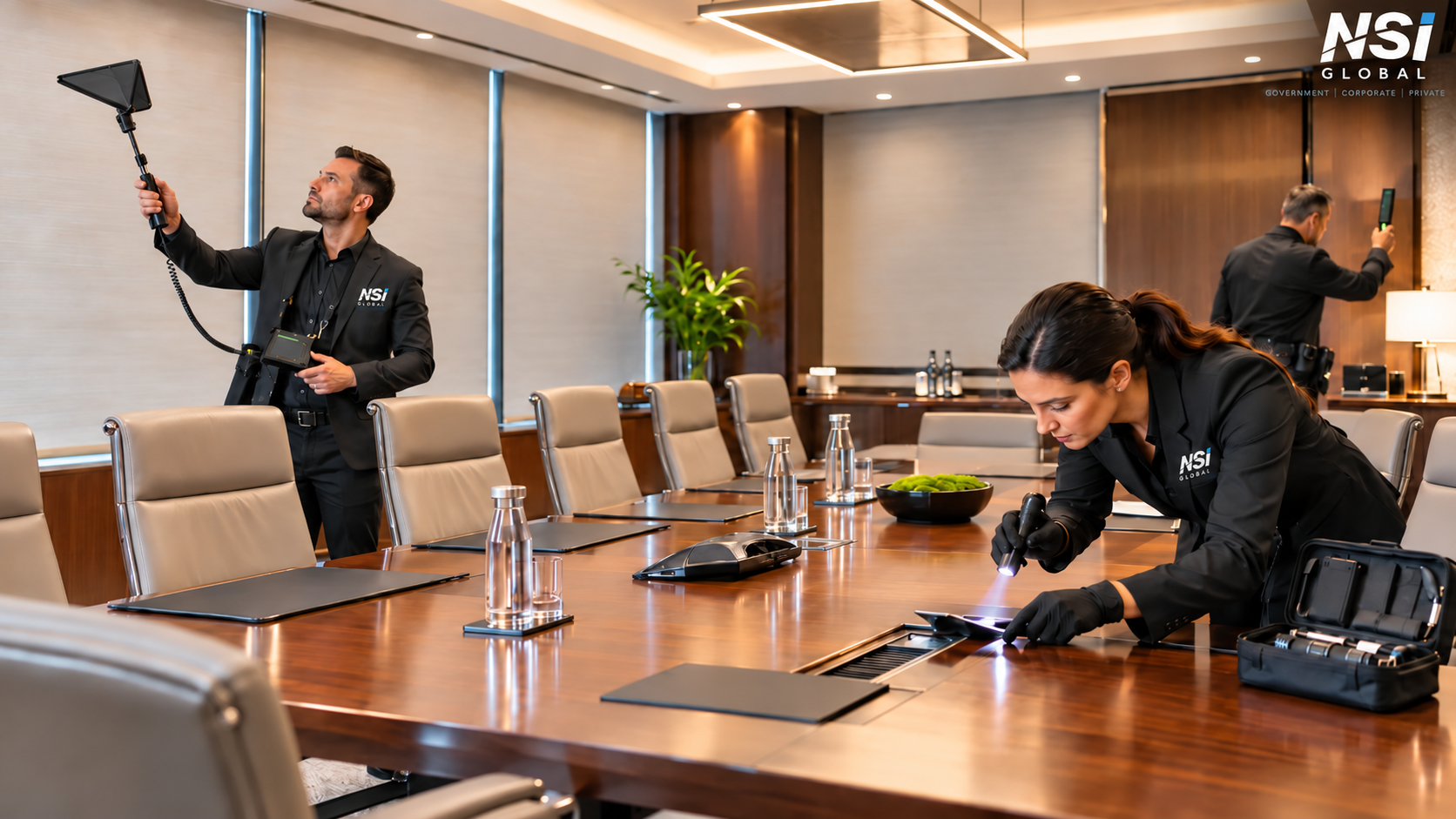
Depending on the threat, a professional TSCM bug sweep may involve hidden camera detection, listening device detection, GPS tracker detection, RF spectrum analysis, physical inspection and other methods appropriate to the environment.
Method selection may include:
- Physical inspection for concealment, tampering and unexplained modifications;
- RF spectrum examination and signal analysis;
- Non-linear junction detection for electronic components, including devices that are not transmitting;
- Inspection of power, cabling, telecommunications and room systems within the authorised boundary;
- Optical examination for covert cameras or line-of-sight collection risk;
- Thermal or other anomaly assessment where conditions make it useful;
- Acoustic-security assessment and examination of sound-leakage pathways;
- Wireless and network enquiries where those systems form part of the agreed scope; and
- Comparison with baseline information, asset registers or prior survey observations.
Each method has limitations. An RF examination may not reveal a recorder that stores data locally, a device that remains dormant during the survey or a transmitter operating outside the observed band or time window. Non-linear junction detection can identify electronic components but does not automatically establish their purpose. Physical inspection depends on access and the examiner’s ability to distinguish legitimate infrastructure from anomalies.
The methods should therefore work together. The report should explain what was used, where it was used, relevant environmental restrictions and which questions remain unresolved.
Live Meetings Create a Different Requirement
A pre-meeting survey and live TSCM monitoring answer different questions.
A survey examines the environment during the inspection period. Live TSCM meeting monitoring observes relevant activity while the sensitive discussion is actually taking place. That distinction can matter where a device is activated remotely, transmits intermittently or is introduced after the pre-meeting inspection.
Live monitoring does not guarantee confidentiality. Its value depends on the sensors, coverage, baseline, venue, RF conditions, staffing, response procedures and other controls used during the event.
High-consequence meetings may require a coordinated package including pre-event survey work, attendee and device controls, communications security (COMSEC), live monitoring and a defined escalation procedure for anomalies. The appropriate design depends on the threat and consequence, not on a generic meeting-room template.
A One-Off Survey Is a Point-in-Time Control
Surveillance risk does not stop when the survey team leaves. A device may be installed later, a trusted insider’s access may change or a new transaction may create a different threat profile.
Organisations should consider repeat or event-triggered work following:
- A merger, acquisition, capital raising or major negotiation;
- Executive appointment, departure or contentious dismissal;
- Construction, refurbishment, relocation or contractor access;
- Unexplained disclosure of confidential information;
- Discovery of suspicious hardware, cabling, signals or room changes;
- A high-stakes board, legal, crisis or government meeting;
- Loss of keys, passes, devices or access credentials;
- A material change in geopolitical or competitive exposure; or
- Use of a third-party venue for sensitive discussions.
Where exposure is persistent, managed or continuous TSCM measures may be more appropriate than relying exclusively on periodic inspections. Fixed or deployable monitoring can extend observation across time, but it still requires correct configuration, baseline management, qualified interpretation and an agreed response process.
What a Negative TSCM Result Means
A negative survey should never be represented as a guarantee that a premises is “clean.” It means the work did not identify a reportable covert device or anomaly within the agreed locations, systems, methods, access conditions and observation period.
Residual exposure may remain where:
- A device was inactive, absent or removed before the inspection;
- Transmission occurred outside the frequency range or observation window applied;
- Information was stored locally for later physical retrieval;
- Access to a room, system, void or third-party service was restricted;
- The relevant surveillance pathway fell outside the commissioned brief; or
- Authorised infrastructure or occupancy changed after the work was completed.
A useful report makes these boundaries visible. Decision-makers can then accept the remaining risk, expand the survey, modify access arrangements, remediate a vulnerability or implement targeted monitoring.
The quality of a negative result is therefore linked to scope. “Nothing detected” following a limited boardroom RF scan provides a very different level of assurance from a multi-method survey covering the credible locations, systems and time periods identified in a documented threat assessment.
Reporting Should Separate Findings, Anomalies and Limitations
A professional report should allow another authorised decision-maker to understand what was done and what the result supports.
It should ordinarily identify:
- The purpose and authorised scope;
- Inspected and excluded areas;
- Relevant dates, conditions and access restrictions;
- Methods and coverage at an appropriate level;
- Legitimate infrastructure requiring explanation;
- Anomalies investigated and how they were resolved;
- Reportable findings and supporting observations;
- Vulnerabilities or practices capable of assisting surveillance;
- Recommended remedial or monitoring measures; and
- Residual limitations affecting interpretation.
The report should not transform an unexplained signal into an allegation without supporting evidence. Nor should it turn the absence of a detected device into proof that surveillance never occurred.
Where an item may become evidence, handling, documentation and referral decisions should be coordinated with legal counsel or law enforcement as appropriate. Immediate removal is not always the correct first action.
Questions Executives Should Ask Before Approving the Scope
Before commissioning a corporate-office TSCM survey, leadership should ask:
- What information or decision are we protecting?
- Who could benefit from obtaining it, and what access might they possess?
- Where is that information discussed, displayed, stored or transmitted?
- Which physical, RF, optical, acoustic, network and account-based pathways are credible?
- Which rooms, adjoining areas, vehicles, residences or third-party venues belong in scope?
- What access restrictions will prevent complete examination?
- Is a one-time survey sufficient for the duration of the exposure?
- What happens if an anomaly or suspected device is identified?
- How will changes after the survey be controlled?
- What will the final report allow the board or legal team to conclude—and what will it not establish?
These questions help prevent price from becoming the sole driver of scope. A lower-cost survey that omits the credible collection channels can be more expensive than a properly designed engagement because it creates confidence unsupported by the work performed.
How NSI Global Develops Risk-Based TSCM Engagements
NSI Global provides technical surveillance countermeasures for corporate, legal, government and other authorised clients. Engagements may cover bug-sweeping services, corporate premises, sensitive meetings, executive residences and vehicles where those environments form part of the risk profile.
The engagement begins with the information at risk, threat actors, access pathways and decisions the client may need to make. NSI Global then defines the authorised locations, systems, methods and observation requirements, records material exclusions and reports findings at the level the evidence supports.
Where the threat extends beyond a covert physical device, the TSCM work may need to be coordinated with corporate investigations, digital forensics, forensic spyware and malware detection, communications security (COMSEC) or broader counterintelligence measures. A compromised executive phone, laptop or communications account may create a surveillance channel that no physical bug sweep can detect. Those workstreams should be expressly commissioned rather than assumed to be included in a generic sweep.
For a confidential discussion about corporate espionage exposure, survey scope or live meeting protection, contact NSI Global.
TSCM Survey Frequently Asked Questions
What Is a TSCM Survey?
A TSCM survey is a professional bug sweep designed to find, assess and reduce technical surveillance risks within a defined environment. Depending on the threat, it may include hidden camera detection, listening device detection, GPS tracker detection, RF analysis, physical inspection, optical assessment and other specialist methods.
Can a TSCM Survey Guarantee That a Room Is Free From Bugs?
No. The result is bounded by the locations, access, methods, conditions and time covered. A well-scoped negative result provides useful assurance but cannot exclude every past, future, dormant or out-of-scope surveillance pathway.
Is an RF Detector Sufficient for a Corporate Bug Sweep?
No single instrument covers every threat. Devices may be wired, passive, locally recording, intermittently transmitting, concealed within legitimate equipment or inactive during inspection. Method selection should follow the threat assessment.
How Often Should an Organisation Conduct TSCM Surveys?
There is no universal interval. Frequency should reflect information sensitivity, threat level, access changes and trigger events such as transactions, executive departures, construction, suspected leakage or important confidential meetings.
What Happens if a Suspicious Device Is Found?
The response depends on safety, legal authority, evidentiary value and operational objectives. Avoid unnecessary handling. Document the circumstances and coordinate with counsel, security leadership or law enforcement before removal where practicable.
Sources and Further Reading
- NIST SP 800-53 Rev. 5 – RA-6 Technical Surveillance Countermeasures Survey
- NSI Global – Technical Surveillance Countermeasures
- NSI Global – Corporate Office TSCM
Publication note: Originally published 26 June 2023. Substantively reviewed and rewritten 9 October 2026.
General information only: The appropriate TSCM scope, lawful authority and response to suspected surveillance depend on the facts, location and jurisdiction.