A hidden camera allegedly found inside a restricted staff area shows why secure perimeters do not eliminate surveillance risk – and why a professional bug sweep must consider insider access, non-RF devices and evidence preservation.
By Claude Khoury, Chief Operating Officer, NSI Global
PUBLISHED: 7 October 2026 UPDATED: 8 October 2026
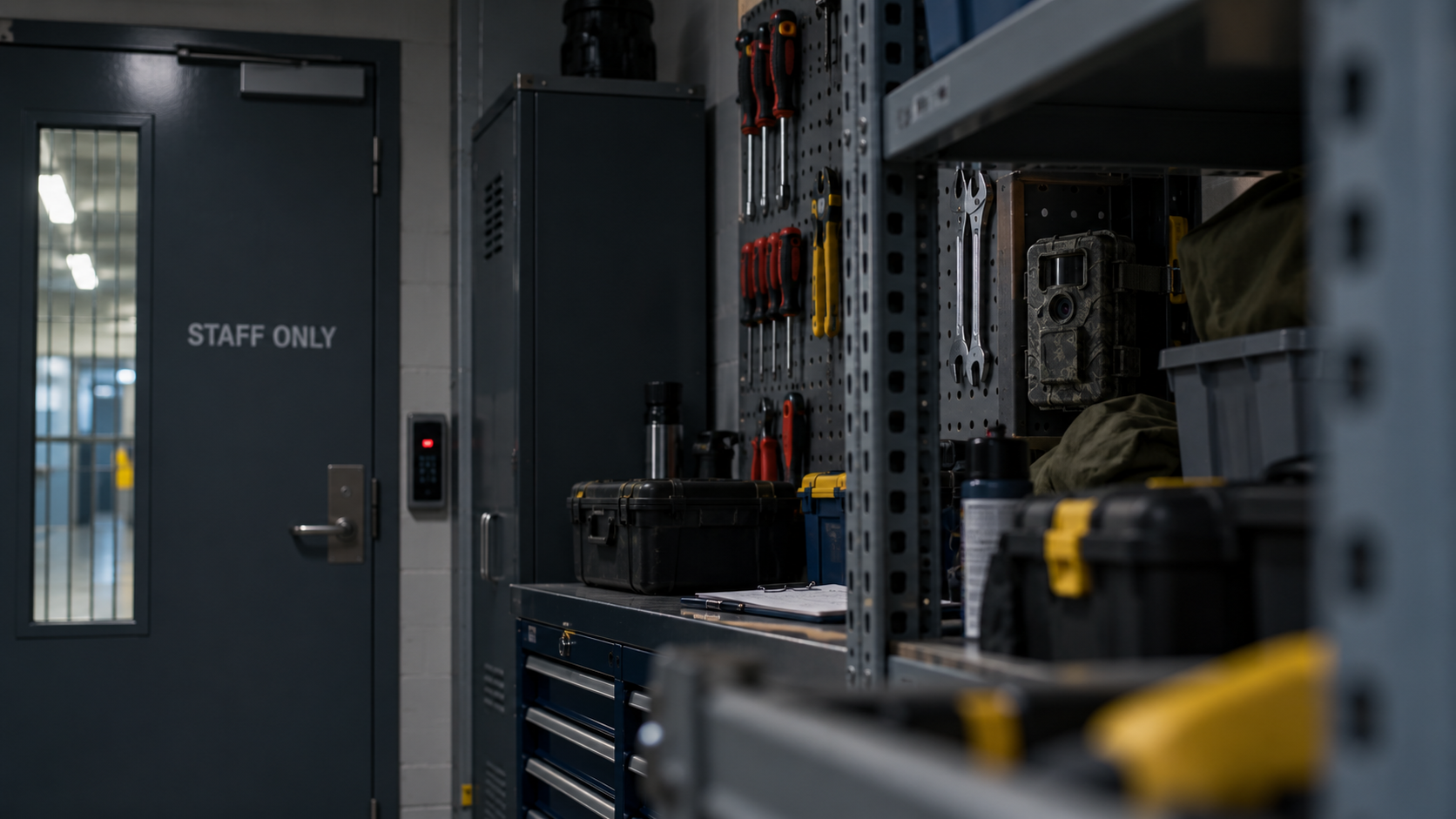
In June 2026, the Public Service Association of NSW reported that a covert trail camera had allegedly been discovered inside a secure, staff-only tool shed at Mid North Coast Correctional Centre near Kempsey. The union took the matter to the NSW Industrial Relations Commission, supplied photographs of the device to Commissioner McDonald and asked that the circumstances be examined under workplace and surveillance law.
The public record does not yet establish who installed the camera, what it recorded, how long it had been present, whether it transmitted data, whether recordings were recovered or whether any criminal or disciplinary breach occurred. Those questions remain for the relevant investigation.
For readers unfamiliar with the term, Technical Surveillance Countermeasures (TSCM) is the professional process of detecting, locating and assessing covert surveillance threats such as hidden cameras, hidden listening devices, GPS trackers and other unauthorised surveillance equipment. In everyday language, this type of inspection is often described as a bug sweep, although professional TSCM extends beyond simply searching for transmitting devices. The incident also raises an important technical-surveillance lesson: a facility can have perimeter security, controlled entry, CCTV, access management and restricted zones while still remaining vulnerable to a covert device placed inside a trusted internal space.
What Was Reported at Mid North Coast Correctional Centre?
On 11 June 2026, the PSA appeared before the NSW Industrial Relations Commission regarding what it described as a covert trail camera hidden in the secure, staff-only tool shed at Mid North Coast Correctional Centre. The union said it provided photographs of the device directly to Commissioner McDonald.
According to the PSA, the Commissioner regarded the circumstances as concerning and expected a comprehensive investigation that included relevant police referrals. The matter was listed to return to the Commission later that month so Corrective Services NSW could provide an update on the progress of its investigation.
The PSA also asked the Commission to consider whether the alleged surveillance engaged the Workplace Surveillance Act 2005 (NSW) and the Surveillance Devices Act 2007 (NSW). As of 7 October 2026, NSI Global has not identified a later public source that conclusively establishes who placed the device or the final outcome of the investigation.
| WHAT IS PUBLICLY ESTABLISHED – AND WHAT IS NOT |
| Publicly reported: the PSA says a covert trail camera was found in a secure staff-only tool shed; photographs were placed before the Industrial Relations Commission; and an investigation was underway.
Not publicly established: who installed the device, the purpose of the installation, what was recorded, whether the device transmitted data, whether recordings were recovered, or whether any person or organisation breached the law. |
Why a Camera Inside a Secure Workplace Matters
Mid North Coast Correctional Centre is a maximum-, medium- and minimum-security correctional facility. Like other secure environments, it operates within layers of physical security intended to control movement, detect prohibited items and protect staff, inmates and infrastructure.
A covert device allegedly found inside a staff-only area therefore creates a different risk question from a camera discovered in a public place. The central issue becomes access: how could the device have reached a restricted environment, who could have placed or serviced it, and what controls should have detected an unauthorised object?
The lesson applies well beyond correctional facilities. Boardrooms, legal offices, laboratories, defence-adjacent sites, utilities, server rooms and executive offices can all be protected by access control while remaining vulnerable to a person who already has legitimate, temporary or compromised access.
Staff-Only Does Not Mean Surveillance-Safe
Security programs often distinguish between public and restricted areas. That distinction is important, but it can also create a false sense of confidence once a person or object has crossed the perimeter.
Trusted spaces can become attractive surveillance locations because they concentrate sensitive conversations and activity while receiving less suspicion from the people who use them. A device hidden in a staff room, workshop, service area, communications cupboard or maintenance space may also be positioned close to the people or infrastructure of interest.
A credible technical-surveillance assessment therefore considers not only the primary room where sensitive activity occurs, but also adjoining rooms, ceiling and service spaces, furniture, fixtures, telecommunications infrastructure, maintenance areas and other locations from which information could be collected.
For corporate environments, NSI Global’s Corporate Office TSCM methodology examines boardrooms, executive offices, meeting rooms and adjoining areas rather than treating the room boundary as the entire security perimeter.
A Hidden Camera Does Not Need to Transmit
One of the most important TSCM lessons from a hidden-camera scenario is that covert surveillance is not necessarily radio-frequency surveillance.
A self-contained camera can be configured to record locally to removable or onboard storage. It may use motion activation, scheduled recording or another local trigger. If it is not transmitting Wi-Fi, cellular, Bluetooth or another RF signal at the time of inspection, a basic RF detector may have little or nothing to detect.
That is why a competent TSCM inspection cannot be reduced to a radio-frequency scan. Depending on the environment and scope, the methodology may need to combine visual and physical inspection with RF analysis, examination of infrastructure and concealment points, non-linear junction detection, thermal or optical techniques and other specialist methods.
NSI Global’s broader Technical Surveillance Countermeasures (TSCM) capability includes hidden camera detection, listening device detection, GPS tracker detection, unauthorised transmitter detection and professional bug sweeps for environments where covert surveillance is suspected.
How Could a Device Enter a Restricted Environment?
The discovery of a device inside a restricted area does not prove insider involvement. It does, however, make the access pathway a central investigative question.
Investigators may need to consider legitimate staff access, contractors, cleaners, maintenance personnel, deliveries, former staff, shared keys or credentials, unattended access points and any period when the area was open for repairs or other works.
The objective is not to identify a suspect by assumption. It is to reconstruct which access opportunities were realistically available and test those opportunities against evidence such as access-control logs, CCTV, rosters, work orders, contractor records, key registers and device metadata.
Finding the Device Is Only the Start of the Investigation
A hidden camera is both a security threat and a potential evidence source. The way it is handled immediately after discovery can affect what can later be established.
Before unnecessary manipulation, the scene and device position should be documented. Relevant observations may include the concealment method, direction of view, mounting, power source, apparent storage media, visible identifiers, nearby objects and the physical route by which the device may have been accessed.
Where appropriate, the device and any removable media may then require controlled forensic preservation. The aim is to avoid altering timestamps, overwriting files, triggering automatic deletion, changing configuration data or contaminating other evidence.
What Digital Examination Might Establish
If lawful authority exists and evidence is recoverable, forensic examination of a hidden camera or its storage media may help answer questions such as:
- What files were created, and when?
- How long does the recording chronology appear to extend?
- Was the device motion-activated, scheduled or continuously recording?
- Are deleted files or file-system artefacts recoverable?
- Does metadata reveal device configuration, time settings or firmware information?
- Was removable storage used?
- Are there indicators of prior use in another location?
- Does the device contain network, pairing or communications artefacts?
- Can the media be correlated with access-control, CCTV or roster information?
The answers depend on the device, file system, storage condition and whether the equipment has been altered since discovery. No responsible examination should assume that every question can be answered.
Where digital evidence may later be scrutinised, Digital Forensic Data Collection and Preservation can help preserve storage media and related electronic evidence under documented chain-of-custody procedures.
Workplace Surveillance and Covert Surveillance Are Not the Same Thing
Many workplaces lawfully use visible CCTV, access-control systems and other monitoring for security, safety and operational purposes. That does not mean every form of hidden surveillance is automatically authorised.
Under the NSW Workplace Surveillance Act 2005, camera surveillance of employees is subject to notice and visibility requirements unless an applicable exception or lawful authority exists. The Act provides that cameras used for employee surveillance are generally to be clearly visible and that signs are to notify people that surveillance may occur.
The Surveillance Devices Act 2007 separately regulates matters including the installation, use and maintenance of optical surveillance devices in circumstances involving entry to premises or interference with property without consent, subject to statutory exceptions and lawful authorisations.
The application of either Act to a particular incident depends on the facts, authority, purpose and circumstances. NSI Global does not express a view on whether the alleged Mid North Coast Correctional Centre installation breached either Act; that question is appropriately left to the relevant investigators, agencies and legal advisers.
What the Case Means for Corporate and Government TSCM
The wider lesson is not that every staff-only area requires constant technical surveillance. It is that risk assessments should not stop at the obvious sensitive room or assume access control makes covert placement impossible.
Organisations handling sensitive commercial, legal, government or security information should understand which internal spaces could be used to observe people, conversations, screens, documents or movement. Those spaces may include service rooms, shared offices, ceilings, storage areas, plant rooms, common areas and locations used by contractors or maintenance personnel.
TSCM is most effective when it is threat-led. The question is not simply ‘is there a transmitting bug in the boardroom?’ It is ‘through what technical pathways could an adversary collect the information we are trying to protect?’
When Should Organisations Conduct a TSCM Bug Sweep?
Routine TSCM bug sweeps can be appropriate for high-risk environments, but certain events should also trigger a reassessment of surveillance exposure.
- Sensitive information appears to be known outside the authorised group.
- A suspicious or unexplained electronic device is found.
- A secure room undergoes renovation, cabling, maintenance or contractor works.
- Access keys, badges or credentials are lost or compromised.
- A high-risk employee, contractor or service provider departs.
- A merger, acquisition, litigation matter, tender or other sensitive transaction materially increases the value of information discussed in the environment.
- There is evidence of insider activity, unauthorised access or unusual movement within restricted areas.
- A previous TSCM bug sweep identified vulnerabilities requiring validation after remediation.
Frequently Asked Questions
Can a Hidden Camera Operate Without Transmitting RF?
Yes. A hidden camera can record locally to onboard or removable storage without continuously transmitting a radio signal. This is one reason an RF-only bug sweep cannot detect every surveillance device.
Will an RF Detector Find Every Hidden Camera?
No. RF detection is useful for identifying active radio transmissions, but a non-transmitting recorder, powered-off device or intermittently communicating device may require other inspection techniques.
Should Staff-Only Rooms Be Included in a TSCM Bug Sweep?
Where those rooms adjoin sensitive spaces, contain infrastructure, provide concealment opportunities or are relevant to the threat model, they should be considered. The scope should follow credible collection pathways rather than room labels alone.
What Should You Do if a Hidden Camera Is Found?
Avoid unnecessary handling or alteration. Document the device in place, restrict access, preserve relevant surrounding evidence and seek appropriate legal, security, police or forensic advice depending on the circumstances.
Can a Hidden Camera Be Digitally Examined?
Potentially. Storage media, file-system artefacts, metadata, configuration information and communications records may assist an investigation where they remain recoverable and there is lawful authority to examine them.
Should Contractor and Maintenance Areas Be Assessed?
Yes, where they create access to sensitive spaces or infrastructure. Technical-surveillance risk can arise through service areas, cabling routes, shared facilities and other locations that sit outside the obvious meeting or executive space.
Why the 2026 NSW Case Matters
The alleged discovery at Mid North Coast Correctional Centre is still under investigation, and the public evidence does not justify conclusions about who installed the device or why.
Its security lesson is nevertheless clear. Restricted access and a secure perimeter are controls, not guarantees. A surveillance device does not have to be wireless, and the person or pathway that introduces it may already have some form of authorised or temporary access.
For TSCM practitioners and security leaders, the response should therefore extend beyond detecting the object. It should preserve the evidence, reconstruct the access pathway, understand the collection capability and identify the control failure that allowed the device to remain in the environment.
Organisations requiring a risk-based assessment of offices, secure work areas, boardrooms or other sensitive environments can contact NSI Global for a confidential TSCM and bug sweep consultation.
Sources and Further Reading
- Public Service Association of NSW – Industrial Relations Commission shares POVB outrage over illegal surveillance, 11 June 2026
- Corrective Services NSW – Mid North Coast Correctional Centre (Kempsey)
- NSW Legislation – Workplace Surveillance Act 2005
- NSW Legislation – Surveillance Devices Act 2007
- NSI Global – Technical Surveillance Countermeasures (TSCM)
- NSI Global – Corporate Office TSCM
- NSI Global – Digital Forensic Data Collection and Preservation