
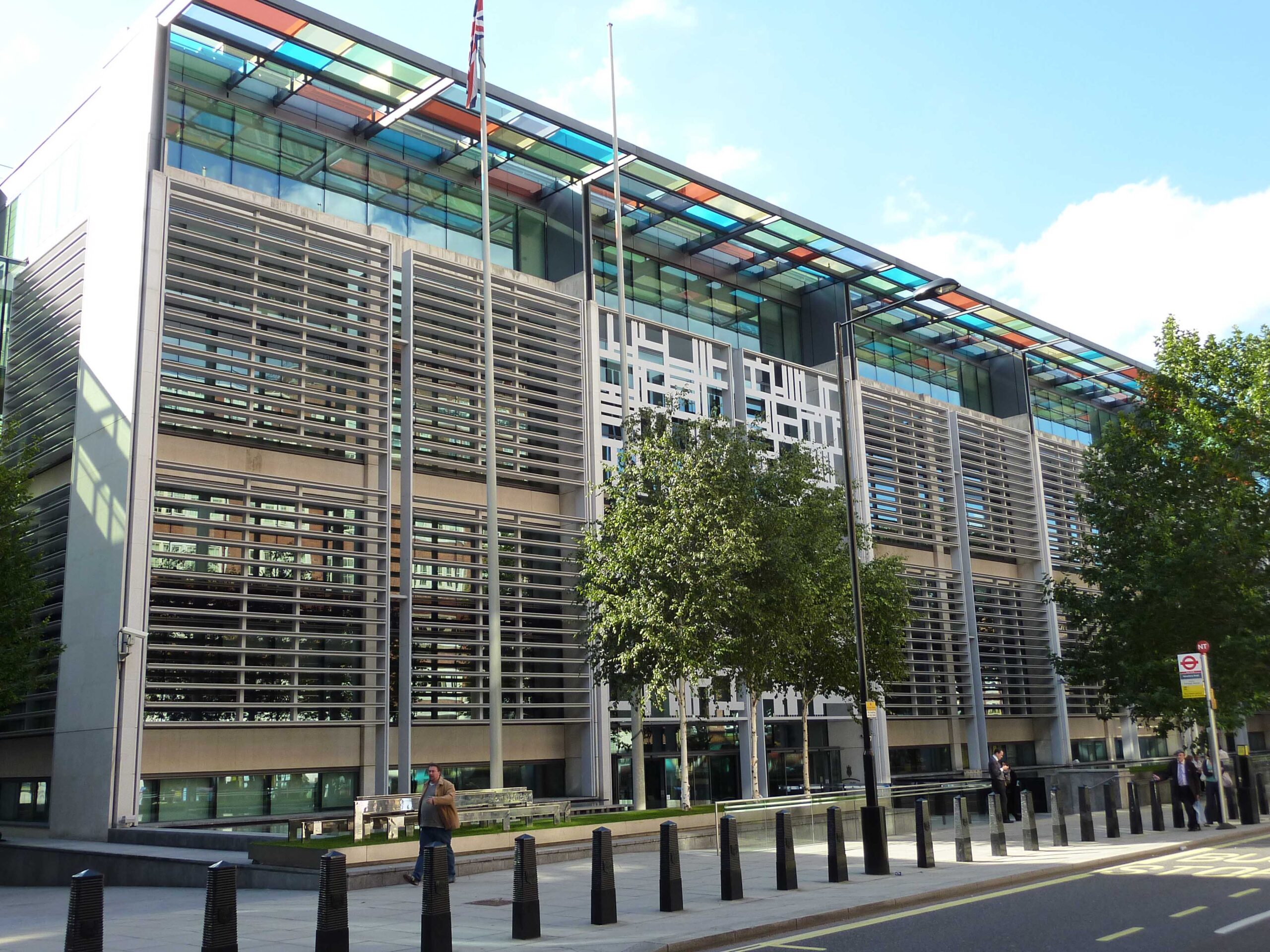
2 Marsham Street, Westminster. Photo: Steph Gray / Wikimedia Commons, CC BY-SA 2.0.
A concealed surveillance device found during a routine security check shows why TSCM must examine the whole environment, not just the boardroom or the radio spectrum.
By: Claude Khoury, Chief Operating Officer, NSI Global
PUBLISHED: 30 September 2026
A surveillance device does not need to be hidden inside a minister’s office, executive boardroom or secure meeting room to create a serious security problem. In June 2026, the UK Government confirmed that an electronic device had been discovered during a routine security check in a communal area of the Ministry of Housing, Communities and Local Government (MHCLG) in Westminster. Media reporting identified the device as a hidden camera concealed within or behind a ceiling panel.
The Government has not publicly disclosed the device’s make, model, power source, recording method, storage capacity, network connection, transmission method or installation date. It has also not attributed the device to a foreign state, insider or other actor. Those unknowns matter. They demonstrate why a credible technical surveillance countermeasures (TSCM) program must distinguish between what has been detected, what can be established from evidence, and what remains inference.
For corporate, legal, government and defence-adjacent organisations, the Westminster case provides a practical lesson: technical surveillance risk is an environmental problem. The relevant attack surface can include adjoining rooms, corridors, ceilings, shared services, furniture, communications infrastructure, executive residences and vehicles – not simply the place where the most sensitive conversation occurs.
What the UK Government Confirmed
On 10 June 2026, Home Office Minister Lord Hanson of Flint told the House of Lords that an electronic device had been found in a communal area of MHCLG during a routine security check. He said the device was not in or near ministerial offices and was being investigated by the appropriate agencies.
The Government’s wording was deliberately cautious. Lord Hanson repeatedly declined to provide further information about the device’s location or the security process that led to its discovery, explaining that the matter was under investigation and that additional detail could prejudice that work.
Media reports published immediately before and after the parliamentary statement described the device more specifically as a hidden camera found in a ceiling panel at the Marsham Street government complex in Westminster. That complex houses major UK government functions, including the Home Office and MHCLG. Reporting stated that the device had been discovered within the preceding two months and that security services had been informed.
What Is Still Unknown About the Device
Public sources do not provide enough information to determine exactly how the device operated. It would therefore be inappropriate to describe it as a Wi-Fi camera, cellular device, radio-frequency transmitter, locally recording camera, wired device or remotely accessible system without further evidence.
- No reliable public source identifies the manufacturer or model.
- No technical specification has been released for the camera or electronic device.
- The Government has not disclosed whether it transmitted continuously, intermittently or not at all.
- No public source establishes whether it recorded locally, transmitted to a remote receiver or used a network connection.
- The power source, battery life, storage method and installation date remain undisclosed.
- No public finding identifies who installed the device, how long it had been present or what information, if any, was captured.
That absence of technical detail is not a weakness in the case study; it is one of its most important lessons. TSCM cannot begin with an assumption about how a surveillance device must behave. A sweep designed only around continuous radio-frequency transmission risks narrowing the investigation before the threat is understood.
TSCM Is More Than an RF Scan
Radio-frequency analysis is an important part of technical surveillance countermeasures, but it is not the whole discipline. A concealed device may be transmitting, dormant, burst-transmitting, network-connected, wired, locally recording, embedded inside another electronic item or operating in a way that makes a simple handheld detector insufficient.
NSI Global’s published TSCM methodology combines visual, electronic and physical examination. Its TSCM capability includes specialist instrumentation such as RF spectrum analysers, thermal imagers and non-linear junction detectors, alongside inspection for hidden cameras, microphones, GPS trackers, burst transmitters, communications interception and other covert surveillance risks.
See: NSI Global Technical Surveillance Counter Measures (TSCM) and Corporate Office TSCM.
The Westminster case should not be used to claim that a specific TSCM technique detected the device; the UK Government has not released that information. What the case does demonstrate is the value of a security program capable of finding an unexpected electronic device during routine inspection rather than waiting for an information leak to expose the problem.
The Surveillance Threat May Sit Outside the Boardroom
The device was found in a communal area rather than in or near ministerial offices. That detail is operationally important. A narrow security scope can protect the obvious high-value room while leaving the surrounding environment exposed.
Sensitive information can be created or disclosed before and after a formal meeting: participants speak in corridors, wait in reception areas, take calls near shared spaces, discuss a meeting while entering or leaving, carry documents through common areas and connect devices to infrastructure outside the room itself.
For that reason, TSCM scoping should be driven by the information and threat environment rather than by room names alone. Depending on the risk, adjoining areas and plausible surveillance positions may require assessment as part of the same security problem.
Shared Buildings Expand the Security Boundary
Large government and corporate buildings are rarely controlled by a single small group of people. They can involve multiple departments or tenants, facilities personnel, cleaners, contractors, maintenance teams, technology providers, visitors and building-management services.
That does not mean those groups should be treated as suspects. It means the number of legitimate access pathways is larger, which increases the importance of access governance, contractor controls, physical inspection and a clear understanding of who can reach sensitive areas and infrastructure.
The same issue arises in commercial towers, law firms, serviced offices, hotels, conference venues and multi-tenant corporate campuses. A technically secure boardroom does not automatically create a secure information environment if the surrounding space is outside the assessment.
Routine TSCM Can Detect a Problem Before a Leak Does
One of the most significant facts in the Westminster case is that the device was discovered during a routine security check. Public reporting does not indicate that the inspection was triggered by a known information leak, a suspicious transmission or a specific allegation.
That supports a central principle of proactive TSCM: the purpose of a routine program is to test the environment before compromise becomes obvious. If an organisation waits until negotiations are leaked, confidential strategy is anticipated by a competitor or internal discussions appear outside the organisation, the intelligence value of the surveillance may already have been realised.
NSI Global’s current corporate TSCM guidance recommends that organisations handling sensitive commercial, legal or government information consider regular cycles – such as quarterly or biannual inspections – with additional checks around higher-risk events including major transactions, board meetings or litigation. The appropriate cadence should be risk-based rather than treated as a universal schedule.
Finding the Device Is the Start of the Investigation
The discovery of suspected surveillance equipment creates an immediate evidence problem. Pulling a device from its concealment, powering it down, connecting it to another system or allowing multiple people to handle it may alter potentially relevant evidence.
The priorities after discovery depend on the circumstances, lawful authority and security risk, but a defensible response may require the scene and device to be documented, access to be controlled, potential digital evidence to be preserved, and technical examination to be coordinated with the appropriate security, legal, forensic or law-enforcement stakeholders.
Questions that may become relevant include whether the device contains stored media, network configuration, timestamps, identifiers, communication history or other artefacts that could assist in establishing how it operated and when it was deployed. Those questions belong to the evidentiary investigation after discovery; they should not be answered by assumption at the sweep stage.
Where electronic evidence must be preserved, NSI Global’s Digital Forensic Incident Response and Digital Forensic Data Collection and Preservation services provide evidence-aware collection, chain-of-custody and forensic preservation capability.
Attribution Requires Evidence, Not Geography or Suspicion
The Westminster discovery immediately generated political speculation because MHCLG had been involved in the planning process for China’s proposed new embassy in London. Members of the House of Lords raised the possibility of foreign-state involvement.
The UK Government did not endorse that conclusion. Lord Hanson repeatedly cautioned Parliament against speculation about who was behind the device, and contemporaneous media reporting stated that there was no suggestion that Russian or Chinese agents were responsible.
That distinction is fundamental to counterintelligence. Finding a surveillance device establishes the presence of a security issue; it does not, by itself, identify the operator. Attribution may require forensic examination, access records, installation opportunities, network evidence, device identifiers, procurement history, witness evidence and other corroborating information.
For organisations dealing with a suspected covert-surveillance incident, premature attribution can distort the investigation and create legal, reputational and operational risk. The evidence should determine the conclusion, not the profile of the most convenient suspect.
What the Westminster Case Means for Corporate Security
The incident is a useful reminder that TSCM is not only a response to an already-proven breach. It is a protective-security function intended to identify covert surveillance risk in environments where valuable information is discussed, displayed, transmitted or carried.
- Scope the environment around the information being protected, not just the room where the meeting occurs.
- Do not assume that every surveillance device will be continuously transmitting a detectable RF signal.
- Treat shared spaces, adjoining areas and legitimate access pathways as part of the threat assessment where the risk justifies it.
- Use routine, risk-based TSCM rather than relying exclusively on suspicion-driven sweeps.
- If a suspected device is discovered, preserve the opportunity to investigate it rather than treating removal alone as the end of the matter.
- Separate the technical finding from attribution: the presence of a device and the identity of its operator are different evidentiary questions.
How NSI Global Approaches Corporate and Government TSCM
NSI Global conducts TSCM for corporate, government, legal and other authorised clients across offices, boardrooms, executive areas, meeting rooms, residences, vehicles and other sensitive environments. Its published methodology combines visual, electronic and physical examination and is supported by specialist equipment restricted from ordinary commercial sale.
The objective is not simply to search for an active transmitter. A properly scoped engagement assesses the environment, examines plausible surveillance pathways, documents findings and provides recommendations to close identified vulnerabilities. Where a discovery may have legal or investigative significance, TSCM can be coordinated with digital forensics and evidence-preservation processes.
For service information, see NSI Global Corporate Office TSCM and Bug Sweeping and Electronic Bug Detection Services. Organisations requiring a risk-based TSCM assessment of offices, boardrooms, executive areas, residences or vehicles can contact NSI Global for a confidential consultation.
Frequently Asked Questions
What Is TSCM?
Technical Surveillance Counter Measures is the specialist process of detecting, identifying and mitigating covert surveillance risks through systematic visual, electronic and physical examination of premises, vehicles, communications environments and relevant equipment.
Can a Hidden Camera Operate Without Transmitting RF?
Yes. A camera can potentially record locally or use a wired or other communications path rather than continuously transmitting a conventional radio signal. The technical method used by the Westminster device has not been publicly disclosed, so no claim should be made about how that particular camera operated.
Can an RF Detector Find Every Surveillance Device?
No. RF detection is one component of TSCM. Devices that are dormant, wired, locally recording, burst-transmitting or concealed within other electronics may require additional inspection methods and specialist instrumentation.
Should Communal Areas Be Included in a TSCM Sweep?
Where the risk assessment supports it, yes. The Westminster case demonstrates why restricting a sweep to the obvious high-value room can leave surrounding areas outside the security boundary. The appropriate scope depends on the information being protected, access patterns, building layout and threat profile.
What Should an Organisation Do if It Finds a Suspected Bug or Hidden Camera?
Avoid unnecessary handling or experimentation. Control access to the area, document what has been found and obtain appropriate security, legal, forensic or law-enforcement advice according to the circumstances. If the device may become evidence, preservation and chain-of-custody considerations should be addressed before it is altered.
How Often Should an Organisation Conduct TSCM?
There is no universal interval. Frequency should be based on exposure, information sensitivity, access changes, major transactions, litigation, executive travel, sensitive meetings and other trigger events. NSI Global’s published corporate guidance notes that quarterly or biannual cycles may be appropriate for organisations handling sensitive commercial, legal or government information, with additional inspections around higher-risk events.
Sources and Further Reading
- UK Parliament Hansard – Concealed Surveillance Equipment in Government Offices and Vehicles, 10 June 2026
- UK Parliament – Urgent Lords Question on Concealed Surveillance Equipment, 10 June 2026
- ITV News – Government confirms hidden camera discovered in offices, 10 June 2026
- The Independent – Hidden camera discovered inside government offices in London, 9 June 2026
- NSI Global – Technical Surveillance Counter Measures (TSCM)
- NSI Global – Corporate Office TSCM