
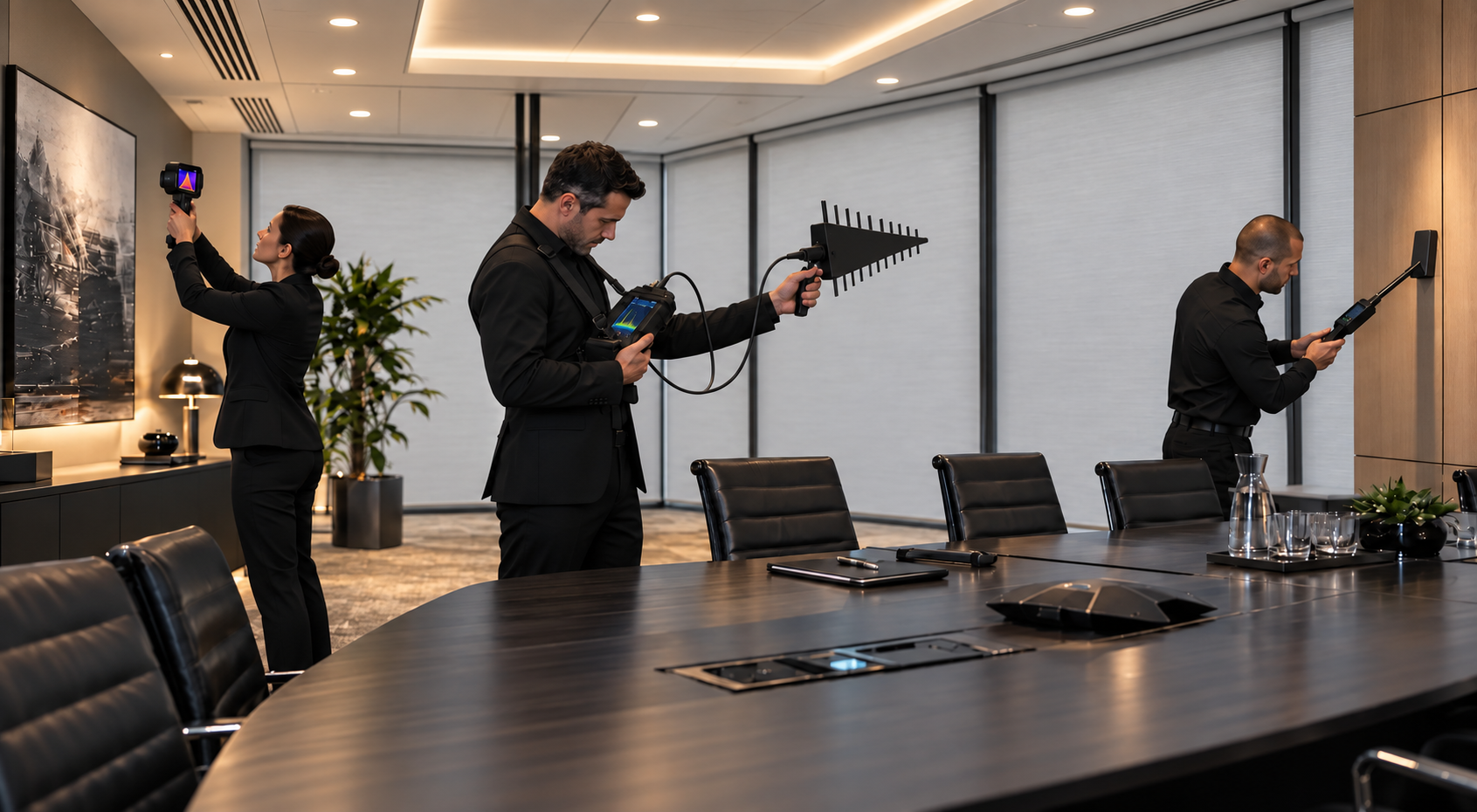
A decision guide for defining scope, interpreting findings, and managing residual surveillance risk.
ORIGINAL PUBLICATION: 6 February 2023 REVISION COMPLETED: 17 September 2026 AEST
By Navid Sobbi, Founder and CEO, NSI Global
A TSCM bug sweep is most useful when it is commissioned as a risk-based technical surveillance survey, not purchased as a generic promise that a room is clean. Its value comes from defining what information is at risk, how it may have been exposed, which locations and systems matter, and what decision the organisation needs to make after the inspection.
This distinction matters. A narrowly scoped survey may be competently completed yet leave relevant rooms, vehicles, communications pathways or periods unexamined. A negative result is therefore not permanent assurance. It is a finding bounded by the agreed scope, methods, access, environmental conditions and time of inspection.
Why a Thorough Scope Is Essential for an Effective TSCM Bug Sweep
Technical Surveillance Counter Measures, usually shortened to TSCM, is a specialist discipline used to identify and assess indicators of covert technical surveillance. Depending on the threat and the authority available, an engagement may include physical inspection, radio-frequency analysis, examination of telecommunications and network infrastructure, assessment of power and cabling, and other targeted methods.
No single instrument or inspection technique can address every surveillance pathway. A transmitting device may be silent during a visit. Another device may store information locally for later retrieval. A disclosure may originate from an authorised device, a compromised account, an insider or an access-control weakness rather than a planted transmitter. For that reason, the practitioner must first understand the risk hypothesis and then select a proportionate combination of methods.
The Australian Government’s Protective Security Policy Framework requires covered government entities to identify and mitigate security risks and vulnerabilities. It also explains that entities apply the framework through a security risk management approach suited to their objectives, threat environment, risk tolerance and capability. Although the PSPF does not make every private organisation subject to the same requirements, the underlying decision principle is sound: protective measures should follow the actual risk.
Seven Business Benefits of a Properly Scoped TSCM Survey
The strongest business case for TSCM is not fear of an unidentified device. It is the ability to test credible surveillance pathways and make better decisions about sensitive operations.
1 Protect Sensitive Discussions and Information
Board deliberations, mergers and acquisitions, litigation strategy, pricing, intellectual property and executive decisions can lose value as soon as an unauthorised party obtains them. A TSCM survey can examine locations and technical pathways associated with those discussions, helping the organisation test whether covert collection may be occurring.
The engagement should begin with the information or activity requiring protection. Starting with a preselected room and ignoring where the information is created, discussed, transmitted or stored can produce false confidence.
2 Test Credible Surveillance Pathways
A professional survey can look beyond obvious radio transmitters. The scope may need to consider non-transmitting devices, recording media, cameras, telecommunications infrastructure, cabling, power, connected equipment, vehicles or temporary meeting locations. The relevant pathways depend on the incident indicators and operating environment.
This is one reason a cheap or tightly limited sweep can be poor value. It may answer only whether a particular method identified a signal in a particular place at a particular time.
3 Detect Indicators Before Further Exposure
Where covert surveillance is present, earlier detection can reduce the period in which sensitive information remains exposed. Even when no device is located, the survey may identify unexplained signals, unauthorised equipment, weak access controls or environmental conditions that justify further work.
TSCM should not be described as guaranteeing early detection. Its practical benefit is that it creates a structured opportunity to find and evaluate indicators before the next high-consequence meeting, transaction or disclosure.
4 Create a Defensible Record for Governance
Executives need more than a verbal assurance that a sweep was completed. A useful report records the agreed scope, areas and systems examined, access limitations, relevant methods, findings, confidence, residual risk and recommended actions.
That record supports internal governance, insurer or client discussions and future security planning. It also allows a later practitioner to understand what was and was not tested instead of repeating an undocumented exercise.
5 Identify Security Weaknesses Beyond a Device
Some engagements reveal no covert device but still expose material weaknesses. Examples may include uncontrolled contractor access, unmanaged equipment, poor meeting-room discipline, vulnerable cable routes, undocumented infrastructure or the absence of a process for handling unfamiliar devices.
These findings can lead to practical improvements in access control, asset management, communications security and staff procedures. The outcome is not proof that every threat has been excluded, but a clearer view of how surveillance risk could be reduced.
6 Support Incident and Legal Response
If a suspicious device or reportable anomaly is found, the next action may affect evidential value. Immediate removal, disassembly or testing by an unqualified person can alter the item, its data or the surrounding scene. The response should be coordinated with authorised leadership and, where appropriate, legal advisers, law enforcement and forensic specialists.
Expert evidence may be available when the practitioner’s instructions, methods, findings and qualifications support it, but court use should never be promised automatically. The engagement needs suitable documentation and evidence-handling arrangements from the outset if litigation is reasonably foreseeable.
7 Establish the Next Protective Action
A well-scoped survey should conclude with decisions, not a vague clean-or-not-clean label. The organisation may accept the residual risk, extend the survey, strengthen access controls, examine a device or account, change the meeting location, schedule another inspection or introduce targeted monitoring.
This turns TSCM from a one-off reassurance exercise into part of the organisation’s protective-security programme.
When Organisations Should Consider TSCM
TSCM is most defensible when there is a defined trigger or a sensitive activity whose consequences justify preventive assurance. Common triggers include:
- A confidential fact appears to be known by an unauthorised person
- Negotiations, litigation strategy or executive decisions are repeatedly anticipated by another party
- An unfamiliar device, cable, signal or change to room infrastructure is observed
- A high-consequence board, transaction, legal or government meeting is planned
- Premises have been refurbished, newly occupied or accessed by numerous contractors
- A key employee, service provider or tenant with privileged access has departed under adverse circumstances
- Travel, temporary offices, hotels, residences, vehicles or vessels form part of the exposure
- A previous survey identified limitations that remain unresolved
Not every information leak requires a bug sweep. The facts may instead point to digital forensics, cyber incident response, an internal investigation or access-log analysis. Early triage helps prevent the organisation from commissioning the wrong discipline.
Match the Survey to the Risk Profile
The question is not simply which rooms should be swept. It is which people, information, locations, systems and time periods form a plausible path between the protected activity and the suspected disclosure.
| Risk indicator | Possible scope implication |
| Confidential board discussions appear outside the organisation | Boardroom, adjoining areas, relevant communications systems, access history and meeting timeline |
| Executive movements or private conversations are unexpectedly known | Authorised residence, office, vehicle, travel locations and connected equipment |
| Disclosure occurs only around particular meetings | Pre-meeting survey, controlled access and live or event-specific monitoring |
| Concern follows refurbishment or contractor activity | Modified rooms, ceiling and service spaces, cabling, new equipment and contractor access records |
| The pattern is intermittent and no anomaly appears during a visit | Repeated inspections, targeted monitoring and review of non-radio-frequency pathways |
| The suspected exposure also involves accounts or devices | Coordinated TSCM, digital forensics and cyber incident response |
A proposal should state the boundaries. If access to a ceiling void, communications rack, third-party service, neighbouring tenancy, vehicle or personal device is excluded, management should understand what risk remains outside the commissioned work.
What a Professional TSCM Survey May Examine
The exact methodology should not be reduced to a public checklist, because it depends on the threat, environment and legal authority. At a high level, the survey may consider:
- Rooms, furniture, fixtures, service spaces and accessible physical concealment opportunities
- Radio-frequency activity and relevant characteristics of the local spectrum environment
- Non-transmitting, dormant, store-and-forward or intermittently active threats
- Telecommunications, network, cabling, power and connected infrastructure within scope
- Cameras, microphones, tracking devices or other unauthorised collection mechanisms
- Vehicles, vessels, aircraft, temporary venues or authorised residences where relevant
- Access-control and operational weaknesses that could enable installation or retrieval
- Evidence-preservation and escalation requirements if an anomaly is discovered
The equipment used matters, but equipment alone does not define competence. The practitioner must be able to interpret the environment, distinguish legitimate infrastructure from suspicious indicators, document limitations and explain what the findings mean for the client’s decision.
How to Interpret Positive, Negative and Inconclusive Results
Positive Result
A positive result means a device or anomaly has been identified and assessed as reportable under the engagement criteria. The immediate priorities are safety, controlled escalation and preservation. Management should avoid broadcasting the discovery or disturbing the item without an agreed response plan.
Negative Result
A negative finding is not an assurance that the location is free of surveillance technology. It records only that, during the inspection, the commissioned techniques did not reveal a device or anomaly meeting the reporting threshold in the areas and systems that could be examined.
Residual risk may remain because:
- Suspect equipment may have been switched off, dormant or taken away before attendance
- An emission may have fallen beyond the monitored frequencies or the available observation window
- Collection equipment may record data without transmitting it from the site
- The team may have lacked necessary access to a room, system, ceiling space or third-party service
- The suspected collection method may not have formed part of the authorised assignment
- Ordinary changes to infrastructure after the inspection may alter the technical environment
The report should expose those qualifications, enabling management to accept the remaining exposure, authorise additional inspection, tighten physical or technical controls, or deploy monitoring against a defined threat.
Inconclusive Result
An inconclusive result means the available evidence or access did not support a reliable positive or negative conclusion. Causes may include severe interference, incomplete access, unavailable infrastructure records, a disrupted scene or an indicator that requires laboratory, digital-forensic or repeat examination.
Calling a result inconclusive is not a failure. It is more credible than overstating what the available conditions allowed the practitioner to determine.
One Survey Does Not Create Permanent Assurance
A TSCM survey is a point-in-time assessment. A room can change after the practitioner leaves. New devices, contractors, visitors, furniture, cabling or access events can alter the environment and introduce new risk.
The appropriate cadence therefore depends on exposure. Some organisations may need an event-triggered survey before a highly sensitive meeting. Others may require periodic inspections tied to access changes, refurbishment or executive travel. Where the threat is persistent or intermittent, live TSCM meeting monitoring or continuous remote TSCM monitoring may provide a different form of coverage.
Monitoring is not automatically superior to a survey. It should be selected because it addresses the identified threat and can be lawfully and operationally supported.
Questions to Answer Before Requesting a Proposal
An organisation can improve both the scope and the commercial value of an engagement by answering seven questions:
- What information, meeting, person or asset needs protection?
- What event or pattern created the concern?
- Which dates, locations, systems, vehicles or communications are relevant?
- Who had authorised or unauthorised access during the relevant period?
- Is the objective preventive assurance, incident investigation, litigation support or continuing monitoring?
- What physical, technical, legal or third-party access restrictions may apply?
- Who will receive findings and authorise escalation if something is discovered?
If the organisation cannot disclose sensitive facts during an initial conversation, it can still describe the consequence, environment and decision required. The practitioner can then identify what further information is necessary before fixing the scope.
How NSI Global Supports TSCM Engagements
NSI Global provides Technical Surveillance Counter Measures for government, defence, law enforcement, legal and corporate matters. Depending on eligibility, authority and risk, support may include bug sweeping services, event-specific monitoring, continuous monitoring and coordinated digital-forensic or investigative work.
Where a matter may proceed to court, NSI Global can assess whether the instructions and available evidence support expert witness services. That decision is engagement-specific and does not replace legal advice.
If covert surveillance is suspected, contact NSI Global from a secure location and device outside the area of concern. Avoid discussing the suspicion in the potentially affected room, removing unfamiliar equipment or alerting people who may be involved. Contact NSI Global for a confidential assessment.
Australian enquiries: 1300 000 NSI (674).
Frequently Asked Questions
Does a negative TSCM survey mean a premises is clean?
No. It means no covert device or reportable anomaly was identified within the agreed scope, methods, access, conditions and observation period. The report should state the residual risk and any limitations.
Can a bug sweep detect every surveillance device?
No responsible provider should guarantee that every device or surveillance pathway will be detected. Assurance depends on the threat, scope, access, timing, environment and methods used.
How often should an organisation commission TSCM?
There is no universal schedule. The cadence should reflect the value of the information, the threat environment, access changes, sensitive events, previous findings and the organisation’s risk tolerance.
Should a suspected device be removed immediately?
Not automatically. Removing or handling it may alter evidence, data or the scene. Secure the area where safe, limit disclosure and obtain advice from authorised management, legal counsel, law enforcement or an appropriately qualified forensic practitioner.
Is TSCM the same as cybersecurity?
No. TSCM focuses on covert technical surveillance risks in physical and electromagnetic environments. Cybersecurity addresses risks to digital systems and data. An incident may require both disciplines, together with digital forensics or a corporate investigation.
Conclusion
The benefit of a TSCM bug sweep is not a certificate that a site is permanently safe. It is a disciplined assessment of defined surveillance risks, supported by transparent findings and a clear explanation of what remains uncertain.
Organisations obtain the greatest value when the scope is broad enough to cover their credible risk profile, yet precise enough to direct specialist effort where it matters. That is what allows a survey to support a defensible decision rather than provide temporary reassurance.