Dated assessment, information cut-off 16 November 2026: This page summarises NSI Global’s MENA Regional Security Assessment for November 2026. It is not a live security advisory. Conditions in the region change quickly, so check current official sources and NSI Global’s latest analysis before making decisions.
PUBLISHED: 16 November 2026
Executive Summary
The Middle East and North Africa enters the next 30 days in a war that has stopped short of ending. There is no formal ceasefire between Iran, the United States and Israel. Iran attacked Bahrain on 13 and 15 November, the Strait of Hormuz is rated at the highest maritime threat level, and a US naval blockade of Iranian ports remains in place. Talks resume in Muscat on 17 November.
The fastest-moving front is Yemen. Houthi forces took the Bab el-Mandeb area on 15 November and say they will advance on Aden, while missiles and drones are fired at Saudi Arabia almost daily. That campaign has moved Saudi Arabia into the ELEVATED band and led the United States to order non-emergency staff out of the kingdom.
The Gulf’s commercial hubs remain open. None of the six Gulf states shows civil unrest above the regional baseline, and their risk sits in armed conflict, infrastructure and the economy rather than in internal stability. North Africa’s risks are domestic: Egypt’s financing deadline on 15 December, Tunisia’s protests, and the end of UN peacekeeping in Western Sahara.
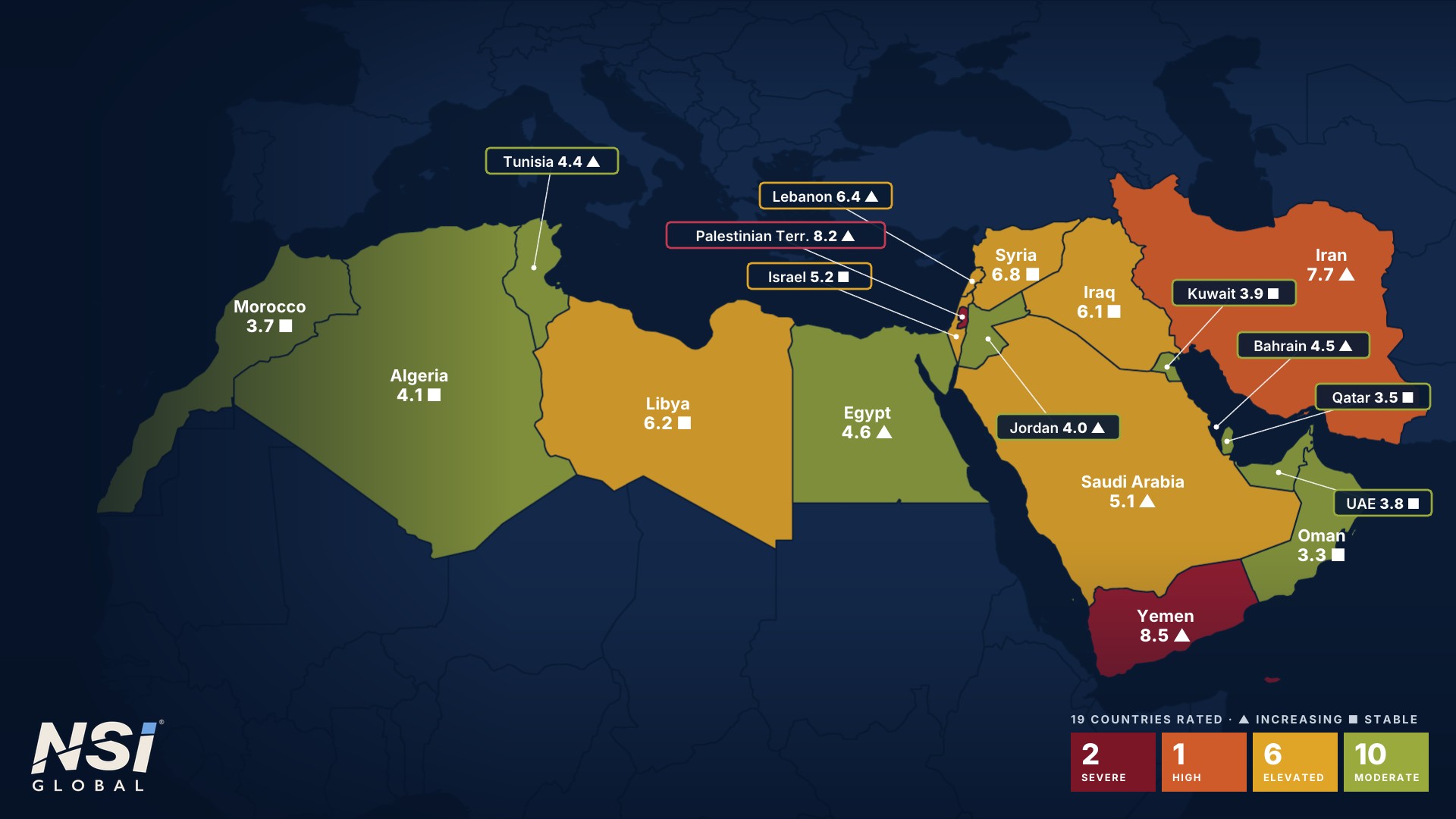
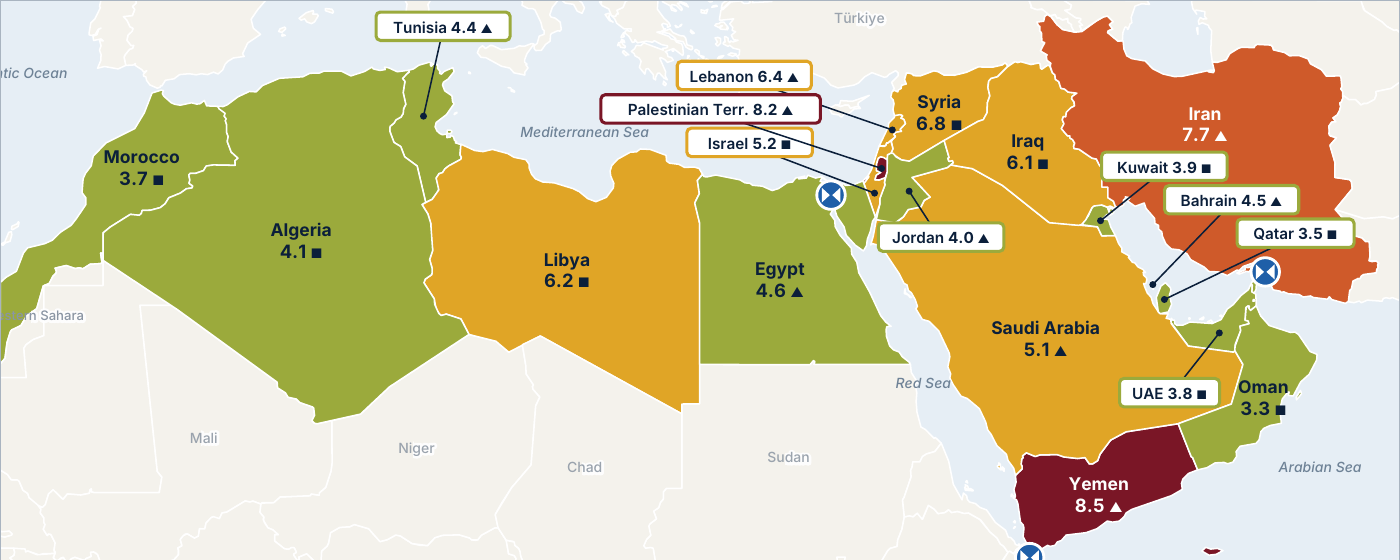
9 of 19 countries are assessed as increasing in risk over the next 30 days and none as decreasing. 2 are rated SEVERE, 1 HIGH and 6 ELEVATED. The full assessment, with a risk card and situation map for each of ten priority countries, is available to download below.
Scope and Time Basis
The assessment covers 19 countries across the Gulf, the Levant, Iran, Iraq, Yemen and North Africa. Each is rated from 1 to 10 on nine domains: governance, armed conflict, economy, civil unrest, information and cyber, infrastructure and medical, natural hazard, tempo and triggers, and security threats.
All information is current to 16 November 2026. The outlook covers the 30 days to mid-December 2026. Every rating rests on official and established sources from 2026, and claims that could not be confirmed are reported as unconfirmed.
Regional Snapshot as at 16 November 2026
| # | Country | Score | Rating | Assessed risk (30 days) | Confidence |
|---|---|---|---|---|---|
| 1 | Yemen | 8.5 | SEVERE | ▲ Increasing | High |
| 2 | Palestinian Territories | 8.2 | SEVERE | ▲ Increasing | High |
| 3 | Iran | 7.7 | HIGH | ▲ Increasing | Moderate |
| 4 | Syria | 6.8 | ELEVATED | ■ Stable | Moderate |
| 5 | Lebanon | 6.4 | ELEVATED | ▲ Increasing | Moderate |
| 6 | Libya | 6.2 | ELEVATED | ■ Stable | Moderate |
| 7 | Iraq | 6.1 | ELEVATED | ■ Stable | Moderate |
| 8 | Israel | 5.2 | ELEVATED | ■ Stable | Moderate |
| 9 | Saudi Arabia | 5.1 | ELEVATED | ▲ Increasing | Moderate |
| 10 | Egypt | 4.6 | MODERATE | ▲ Increasing | Moderate |
| 11 | Bahrain | 4.5 | MODERATE | ▲ Increasing | Moderate |
| 12 | Tunisia | 4.4 | MODERATE | ▲ Increasing | Moderate |
| 13 | Algeria | 4.1 | MODERATE | ■ Stable | Low |
| 14 | Jordan | 4.0 | MODERATE | ▲ Increasing | Moderate |
| 15 | Kuwait | 3.9 | MODERATE | ■ Stable | Moderate |
| 16 | United Arab Emirates | 3.8 | MODERATE | ■ Stable | Moderate |
| 17 | Morocco | 3.7 | MODERATE | ■ Stable | Moderate |
| 18 | Qatar | 3.5 | MODERATE | ■ Stable | Moderate |
| 19 | Oman | 3.3 | MODERATE | ■ Stable | Moderate |
Reading the table: LOW 1.0 to 2.9, MODERATE 3.0 to 4.9, ELEVATED 5.0 to 6.9, HIGH 7.0 to 8.9, SEVERE 9.0 to 10. Yemen and the Palestinian Territories are rated SEVERE because the territory is at war. Assessed risk is where the rating is heading over the next 30 days. Confidence is how well the evidence supports the rating.
Key Judgements
- The US–Iran stalemate is likely (55–80%) to hold through mid-December. Sporadic strikes and attacks on shipping continue, Hormuz stays restricted and Gulf airports and ports stay open with periodic alerts. Both sides signal readiness to strike, so a single incident could end the stalemate quickly.
- Saudi Arabia’s risk is rising and is likely to keep rising while the Houthi offensive continues. Interceptions over Riyadh, the Eastern Province and the Makkah region on 15 November, strikes on airports and the East-West pipeline, and five governments warning against travel place the kingdom at ELEVATED 5.1.
- Gulf states are exposed through infrastructure and the economy, not through instability at home. The IMF expects contractions of 16.7% in Kuwait, 15.6% in Qatar and 11.3% in Bahrain in 2026. Utilities, airports and healthcare are operating, and insurers have restored standard cover in the UAE.
- Lebanon is the most likely site of the next major escalation outside the Gulf. Israel holds a strip of the south and struck the Nabatiyeh district on 15 November; UN peacekeepers leave at the end of December; Israel’s coalition deadline falls within weeks. A renewed Israeli campaign is widely expected if strikes on Iran resume.
- North Africa’s triggers are economic and political, and a direct Algeria–Morocco clash is unlikely (20–45%). Egypt must complete its final IMF review before 15 December; Tunisia has seen its largest protests against the president in years; the Polisario declared a general mobilisation on 10 November after the UN mission’s mandate lapsed.
What the Assessment Means for Organisations
Gulf Hubs Remain Open but Exposed Through Infrastructure
None of the six Gulf states shows civil unrest above the regional baseline. Their exposure sits in shipping, aviation, energy and digital infrastructure. Ships have been attacked off the UAE and Omani coasts in November, satellite-navigation interference in the Gulf rose from 12 November, and flights on some routes are cancelled or restricted.
Saudi Arabia Requires Active Risk Management
Saudi Arabia is rated ELEVATED and increasing. Missiles and drones were intercepted over Riyadh, the Eastern Province and the Makkah region on 15 November, and all five governments whose travel advice we compare warn against travel to the kingdom.
Where Governments Advise Against All Travel
The United States, United Kingdom, Canada, Germany and Australia all advise against travel to Yemen, Iran, Syria, Libya and Iraq. Advice for the Gulf states is divided: the UK has issued no travel warning for Kuwait, Bahrain, Qatar, the UAE or Oman, while other governments advise reconsidering or avoiding non-essential travel to several of them.
Dates That Could Change the Picture
- 16 November: European airspace bulletins for the Gulf, Iran, Iraq, Saudi Arabia, Lebanon and Jordan reach their stated validity date. No renewals had been published at cut-off.
- 17 November: Iran’s foreign minister in Muscat; US–Iran talks resume.
- Week of 16 November: US president due to discuss the war with the Russian and Chinese leaders.
- Late November to December: Deadline for Israel’s prime minister-designate to form a coalition (28 days from the mandate, with a possible 14-day extension).
- 15 December: Egypt’s IMF program expires; about $2.3 billion depends on the final review.
- 31 December: Mandate of the UN peacekeeping force in Lebanon ends. Qatar’s LNG force majeure runs through December.
- March 2027: The IMF’s baseline assumes Hormuz begins to reopen.
Operational Measures to Consider
Crisis Governance and Decision Triggers
Agree now what the organisation will do if strikes on Iran resume: who relocates, by which route, and who decides. Tie those decisions to named triggers, such as the warning indicators set out in the assessment. NSI Global’s Business Continuity capability supports organisations in building and testing those plans.
Workforce Travel
Review travel country by country and journey by journey. Build slack into Gulf itineraries, limit travel to Saudi Arabia to what is essential, and defer travel to the countries where governments advise against all travel. Travel Intelligence briefings can support journey-level decisions.
Shipping, Aviation and Supply Chains
Treat transits of the Strait of Hormuz and waiting time at the Fujairah and Khor Fakkan anchorages as high risk, and expect delay. Brief aviation and maritime crews on satellite-navigation interference. Counterparties to Qatari LNG contracts should review their exposure to force majeure.
Medical Planning
Medical capacity varies sharply across the region. Care is of a high standard in the Gulf states and Israel, limited outside the major cities in Iran and Egypt, and not to be relied on in Syria or, for serious cases, in Iraq. Carry insurance that covers treatment and evacuation, and plan evacuation routes before travel rather than during an emergency.
Cyber and Communications Readiness
Iran has publicly threatened data centres and cables in the UAE linked to the United States. Organisations that depend on Gulf-hosted systems should confirm failover arrangements and incident response contacts. Digital Forensic Incident Response support should be arranged before it is needed.
Download the Full Assessment
The full MENA Regional Security Assessment is a 32-page report, free to download. It contains:
- Ratings, assessed risk and confidence for all 19 countries, with a risk profile chart for each.
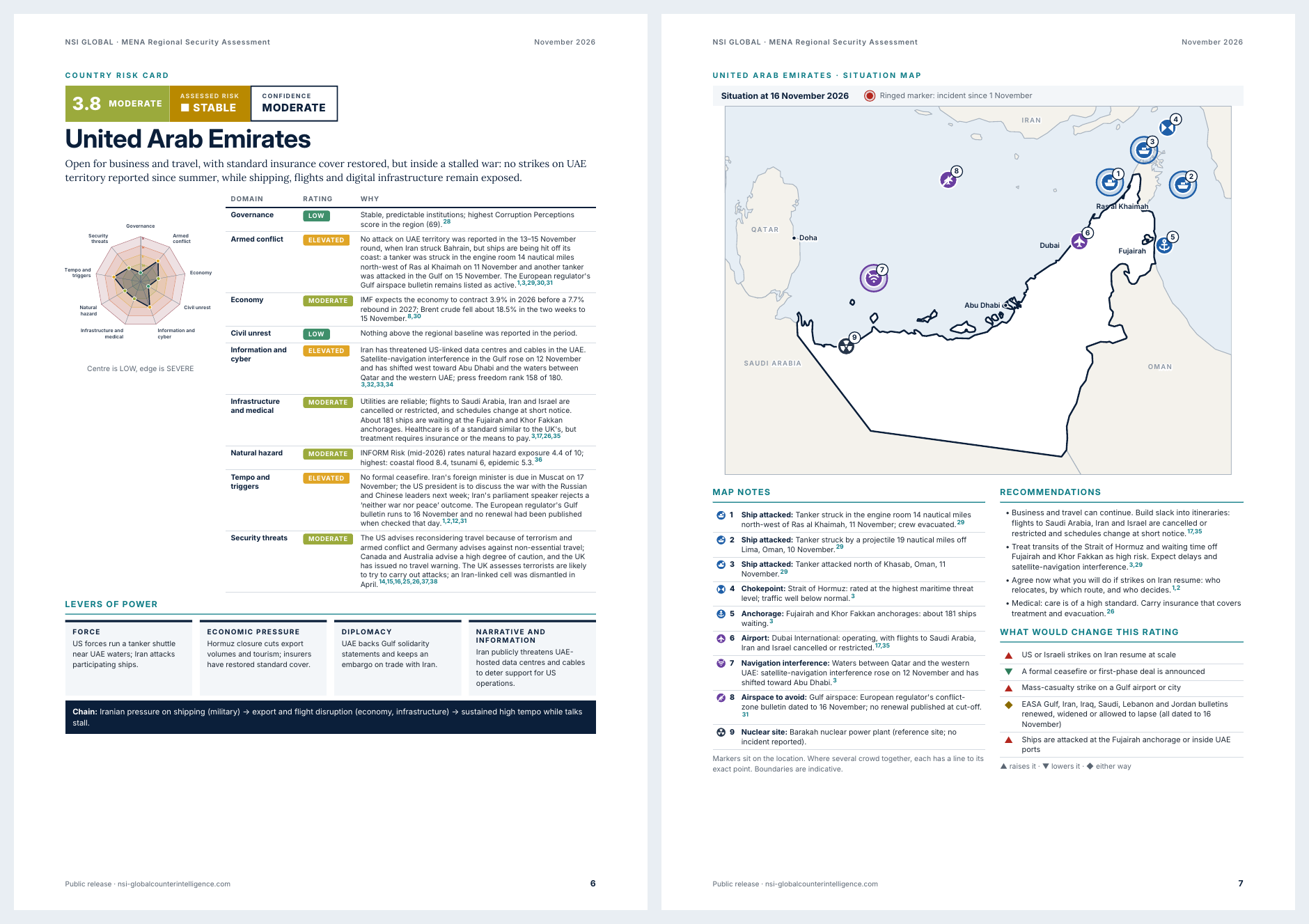
- A two-page risk card for each of ten priority countries: the UAE, Saudi Arabia, Qatar, Kuwait, Iran, Iraq, Israel, Lebanon, Syria and Egypt.
- A situation map for each priority country, marking incidents, strategic sites and restricted areas.
- Travel advice from five governments compared side by side.
- Recommendations, outlook scenarios, dates to watch and the developments that would change each rating.
- Numbered sources for every statement.
How NSI Global Supports Organisations in the Region
- Geopolitical Intelligence: regional and country assessments, including a regional intelligence subscription with monthly assessments, country risk cards, priority alerts and a 30-day outlook.
- Travel Intelligence: journey and destination briefings for travelling staff and principals.
- Business Continuity: crisis governance, decision triggers and continuity planning.
- Digital Forensic Incident Response: investigation and response to cyber incidents.
- Technical Surveillance Counter Measures and Communications Security (COMSEC): protection of sensitive meetings and communications.
Organisations that need more than reporting can discuss NSI Global’s Managed Intelligence, Counterintelligence and Risk Program, which combines these services under one agreement. Assessments of other regions, single countries or an organisation’s own sites are commissioned services and are scoped on request.
For a confidential discussion, contact NSI Global or call the Dubai office on +61 2 9045 1811.
Frequently Asked Questions
Is This a Current Security Advisory
No. It is a dated assessment with an information cut-off of 16 November 2026. Official government directions and current advisories take precedence.
How Are the Ratings Set
Each country is rated on the same nine domains against fixed criteria, using official and established sources from 2026. Every rating is reviewed and approved before release.
What Do Assessed Risk and Confidence Mean
Assessed risk is the direction the rating is expected to move over the next 30 days: increasing, stable or decreasing. Confidence is how well the evidence supports the rating: high, moderate or low.
Which Governments’ Travel Advice Is Compared
The United States, United Kingdom, Canada, Germany and Australia, as published on 16 November 2026. Travel advice is shown for comparison. It is one input and does not set the rating.
Can NSI Global Assess Another Region or Our Own Sites
Yes. Other regions, single countries and site-specific assessments are commissioned services. Contact NSI Global to discuss scope.
General information only: This assessment is based on open sources at the cut-off date and does not replace government directions, legal advice, official travel advice or an organisation-specific security assessment.